Mar 31, 2026

Pentana

Pentana is a 1978 game by Larry Yoos, published at Pentana Enterprises.

The game is a moku variant played on a 4x4 board, with four pieces per player.

Rules:

  • Initially, the pieces are placed on each player's first row
  • On his turn, the player moves a friendly piece to any adjacent empty square (orthogonally or diagonally)
  • Wins the player that makes a 4 in-a-row with his pieces (except at the row where his pieces begin) or by placing the pieces in the four board corners.

The game seems too simplistic to work properly. If a player places three pieces in a main diagonal (excluding the adversary row), the adversary only has one way to win, which is to make one column, and that column can easily be blocked by the player's fourth piece.

Not sure why the name has the root 'penta' in it, since that means five. Perhaps it as something to do with the success of Pente (published at 1977).

A game ad at Games #24:

Mar 26, 2026

Quadringentesimus Quadratum

Quadringentesimus Quadratum is a 2002 game by Martin Schlegel, published at Spielbox magazine #4.

Each player has 17 pieces, and there's an extra neutral stone that starts at the central marked square.

Rules

  • Players alternately drop their pieces on empty squares, following these rules:
    • The first player drops one piece.
    • The second player then drop two pieces; the second must be directly east or west of the first.
    • The first player then drops two pieces; the second must be directly north or south of the first.
    • Play continues in this alternating double-placement pattern, with the required adjacency constraint depending on the previous opponent’s move.
  • Pieces cannot be placed on the square occupied by the neutral stone.
  • Pieces cannot be placed on a square that lies directly between two opposing pieces in a straight orthogonal line (unless that line is interrupted by the neutral stone or one of your own pieces).
  • If a player cannot drop their required second piece, they place only one. 
    • Passing is not allowed if a legal placement exists.
  • The game ends when all pieces are placed or no further legal placements are possible. 
    • For scoring, count all empty spaces that lie between two of your pieces in an uninterrupted orthogonal line. The player with the higher total wins the game.

Mar 22, 2026

Interaction

Interaction is a 1978 uncredited game, published by Waddingtons.

The game is played on the following 9x9 board without the four corners, with a middle row made of 'pockets':

Each player has two pieces (the cue balls) and there are ten neutral yellow pieces. The pieces are placed in any symmetric position.

Rules:

  • On her turn, the player 'sends' a friendly cue balls in any one of the eight directions. The ball will travel, eventually bouncing the edges, until it hits another ball (of either color, or neutral). 
    • If the ball hits a row of balls, only the farthest one starts moving
    • The energy transferred to the new moving ball is the number of squares the previous ball has traveled
    • A neutral piece landing or moving over a pocket is captured by the player
    • The player's initial move is only valid if it hits at least one ball
  • Wins the player that captures five neutral stones

A review from Games & Puzzles:

Mar 19, 2026

Confounded

Confounded is a 1977 uncredited game, published at Lionshare.

The game is played in a 3x9 board divided in three equal sections,

Each player has nine pieces, three labelled 1, three labelled 2, and three labelled 3, which start at the board (check setup below). Pieces move forward, and the label defines their moving range. There are three different possible ways to win the game: (a) by partial traversal, (b) by stalemating, (c) by capturing.

Here are the official rules:


An abstract game with too many winning conditions usually is a sign that the rules do not play well together, which I think it the case here. The same happens with the remaining ruleset: instead of going back to simplify and make the core rules work, the way was to add more special cases and different ways of capture...


I'm afraid it is not, in fact, the most intriguing game in centuries...

Crosso and Chains

Crosso and Chains are two games by C.S.Elliott, published at Games and Puzzles magazine #42,

Here is the excerpt that introduces both games:

Mar 15, 2026

Torno

Torno is a game which I don't know the author and its date (but it is older than 1900). The game was  published by Villard et Weill in France.

The board and the initial position of each of the nineteen pieces per player:

Rules (here adjacency means orthogonally or diagonally, so a square has eight adjacencies):

  • On his turn, the player picks a friendly piece and either:
    • moves it to an adjacent empty square
    • jumps over an adjacent piece (of either color) and lands in the next square (that must be empty)
      • jumps  can be multiple and change direction; the only restriction is that a piece cannot stop its jump sequence in its initial square (so the board must change position at each move)
      • jumps do not capture enemy pieces
  • Wins the player that first occupies the adversary starting position

This is a direct variant of Halma, which was published in 1884. Chinese Checkers, another variant of Halma, is from 1893.

Here are the accompanying rules in French:

The original text:

TORNO

Ce jeu nouveau et très intéressant se joue à deux sur un plateau divisé en carrés et au moyen de deux fois 19 pions de deux couleurs différentes. Aux extrémités du plateau, 19 carrés sont entourés d'une ligne de séparation. Les carrés marqués et compris dans les lignes de séparation sont appelés camps.

RÈGLE DU JEU

On place le plateau de manière que chaque joueur ait en face de lui son camp de 19 carrés. Chacun garnit le sien avec des pions de sa couleur.

Le but du jeu est, pour chacun, de faire sortir les pions de son camp et de les faire arriver, le plus vite possible, dans le camp opposé. Celui qui y réussit le premier, gagne. Il faut, pour atteindre ce résultat, de 60 à 80 mouvements.

Il y a deux sortes de mouvements :  

Le premier, le pas, par lequel on fait passer un pion d’un carré sur l’un des 8 carrés environnants. (C’est la marche du roi aux échecs).  

Le second, le saut, par lequel on fait sauter un pion par-dessus un autre, quelle qu’en soit la couleur, placé sur un carré voisin pour retomber sur un carré vide, et l’on continue ainsi, ce qui fait partie du même mouvement, dans n’importe quelle direction, tant que la disposition des pièces le rend possible et avantageux. Mais, dans ce cas, le pion ne peut sauter que sur un carré de la couleur que celui d’où il est parti.

On ne peut faire qu’un pas par mouvement, on peut faire un nombre illimité de sauts. Avec le pas, il est facultatif d’aller d’une couleur à une autre. Avec le saut on doit toujours rester sur la même couleur. Chacun, à tour de rôle, a droit à un coup, pas ou saut, au choix. Contrairement à ce qui se fait pour le jeu de dames ou celui des échecs, les joueurs ne se prennent pas leurs pions.

Le jeu se divise en trois parties, savoir :  

La marche en avant des pions. — Il faut avoir soin de se ménager des échelles, afin de faire arriver ses pions le plus loin possible par un seul mouvement. On peut quelquefois, par ce moyen, faire sauter un pion d’une extrémité à l’autre du plateau. On cherche, naturellement, à entraver, de temps à autre, la marche de son adversaire ;  

La mêlée. — C’est l’encombrement qui a lieu, tôt ou tard, quand tous les pions se rencontrent au centre et se bloquent de telle sorte que, pour avancer, le seul moyen, souvent, est de faire un long détour ;  

L’arrangement des pions dans le camp opposé. — C’est la partie la plus difficile. De la façon dont on dispose ses pions dès l’entrée dans le camp adverse, dépend tout le succès.  

Il faut éviter de laisser encombrer les abords de ce camp, et, autant que possible, échelonner en tous sens des pions qui aident à arriver aux extrémités.  

Un seul pas bien calculé peut épargner toute une série de mouvements.

Recently, the new database of French boards games, Histoire en Jeux, went online and provides more pictures of the game,


Mar 9, 2026

Les Crocs

Les Croks is an uncredited game that appears in Patrick Carpentier rule's collection. Unfortunately, the document is very sparse with information. The only date we can deduce is that the game is older than 1995-2000, the years where the collection was written.

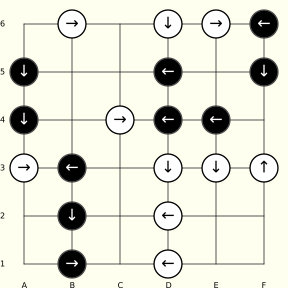
The game is played on an initially empty 6x6 board. Each player has ten pieces (les croks, i.e., the fangs) all marked with a direction (e.g., an arrow).

Rules:

  • In a first phase, players take turns dropping a friendly piece on an empty square. 
    • Here's a board example after the end of this phase:
  • In the second phase, each player picks a friendly piece and can either:
    • move it to an adjacent empty square
    • move it twice in its forward direction
    • rotate it one quarter left or right
    • capture by replacement in its forward direction, unless the enemy piece is faced towards it
      • in the previous board, d6 can capture d5, but e6 and f7 cannot capture each other
  • Wins the player that captures all enemy pieces

There is a related game at the same collection, quite probably by the same unnamed author, called La Saga des Croks.

  • Here players only drop six pieces each, the other four stay in reserve.
  • The capture is changed to emulate reproduction: it is only possible to attack from behind.
    • The 'jumped-over' crok is not removed from the game. 
    • On the next turn, the attacking crok slides to an adjacent orthogonal empty square without changing orientation, and the player places a new crok from the reserve on any empty square. 
    • This new Crok must not be in a 'capture' position.
  • Wins the player that drops on the board his four pieces initially in reserve.

This second game was also described at Jeux et Stratègie #28 by Michel Brassinne:

Mar 5, 2026

Orbit

Orbit is a 1975 uncredited game, published by Clipper.

The game is played on a 15x9 board, Each player has eight tiles and one pawn.

Rules

  • Each player places their pawn on one of the starting spaces (marked by the star) at the edge of the board.
  • The player who starts can either (a) move their pawn, (b) place a tile on board, (c) remove a tile
  • A pawn can advance horizontally or vertically by one square.
  • Tiles can be placed on the board, except on: 
    • The starting space
    • The center squares
    • The squares on the finish line
  • Players can place their pawns on their own tiles, but not on the opponent's tiles.
  • A confined (or trapped) pawn can no longer advance for three turns (check figure 3 below). 
    • The pawn must then restart from a starting space. 
  • The winner is the one who first places their pawn on the last line

The original rules in Dutch and French:


Mar 2, 2026

King of the Castle

King of the Castle, aka Montana, is a 1975 game by Mordecai Meirowitz, and published by Hasbro, among others.

The game is played on this board with six concentric circles (the Castle), having eight paths (or stairs) going from the bottom circle to the top circle (the levels):

Rules:

  • Initially, players receive eight pieces, and place them in stacks of two, in alternating fashion
  • The pieces can move upwards or downwards from one path to the next or sideways to adjacent paths on the same level.
  • Pieces of any color can be stacked to form stacks (towers) of any height.
  • A tower can only be moved by the player whose piece is on top. Using this "capture tactic," a player can block the opponent’s pieces or move them to a lower level.
  • On his turn, a player moves a single piece, or an entire tower with a friendly piece is on top. 
    • In the case of a tower, the move consists of as many steps as there are pieces in the tower.
    • The entire tower is lifted, and the bottom piece is placed first, followed by the next, and so on until the top piece is placed. For example, in a tower of three pieces, the bottom piece can be moved up one level, the next piece can be moved down, and the top piece can be moved sideways, or any other combination of steps on adjacent paths (notice that a player can move enemy pieces that belong to the moving tower).
    • Each move can be made to an occupied place, placing that stone on the top of the other pieces standing there. 
    • Only one piece can be placed at the top circle, per turn.
    • A piece on a top circle can no longer move.
    • If a player cannot make a move, he must pass his turn.
  • Individual pieces or towers cannot be captured on the bottom or top levels.
  • Wins the player that first moves his eight pieces into the center circle (the highest level of the Castle).
    • Each player can only occupy four of the eight places in the top circle, and at least two of these must be adjacent.

This is a little game with lots of rules. Some rules are just exceptions, or addendums, that seem to exist to compensate for the lack of overall design. Even so, it would be nice if the rules explicitly stated if pieces can move over stacks of any size. The rules seem to assume so, but I wonder if forcing a size restriction could introduce extra tactical depth to the game.

Here's a review from GAMES #2: