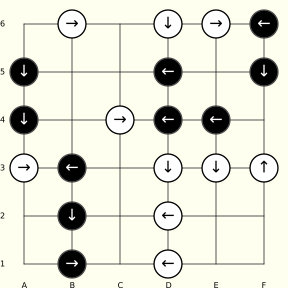
Torno is a game which I don't know the author and its date (but it is older than 1900). The game was published by Villard et Weill in France.
The board and the initial position of each of the nineteen pieces per player:
Rules (here adjacency means orthogonally or diagonally, so a square has eight adjacencies):
- On his turn, the player picks a friendly piece and either:
- moves it to an adjacent empty square
- jumps over an adjacent piece (of either color) and lands in the next square (that must be empty)
- jumps can be multiple and change direction; the only restriction is that a piece cannot stop its jump sequence in its initial square (so the board must change position at each move)
- jumps do not capture enemy pieces
- Wins the player that first occupies the adversary starting position
This is a direct variant of Halma, which was published in 1884. Chinese Checkers, another variant of Halma, is from 1893.
Here are the accompanying rules in French:
The original text:
TORNO
Ce jeu nouveau et très intéressant se joue à deux sur un plateau divisé en carrés et au moyen de deux fois 19 pions de deux couleurs différentes. Aux extrémités du plateau, 19 carrés sont entourés d'une ligne de séparation. Les carrés marqués et compris dans les lignes de séparation sont appelés camps.
RÈGLE DU JEU
On place le plateau de manière que chaque joueur ait en face de lui son camp de 19 carrés. Chacun garnit le sien avec des pions de sa couleur.
Le but du jeu est, pour chacun, de faire sortir les pions de son camp et de les faire arriver, le plus vite possible, dans le camp opposé. Celui qui y réussit le premier, gagne. Il faut, pour atteindre ce résultat, de 60 à 80 mouvements.
Il y a deux sortes de mouvements :
Le premier, le pas, par lequel on fait passer un pion d’un carré sur l’un des 8 carrés environnants. (C’est la marche du roi aux échecs).
Le second, le saut, par lequel on fait sauter un pion par-dessus un autre, quelle qu’en soit la couleur, placé sur un carré voisin pour retomber sur un carré vide, et l’on continue ainsi, ce qui fait partie du même mouvement, dans n’importe quelle direction, tant que la disposition des pièces le rend possible et avantageux. Mais, dans ce cas, le pion ne peut sauter que sur un carré de la couleur que celui d’où il est parti.
On ne peut faire qu’un pas par mouvement, on peut faire un nombre illimité de sauts. Avec le pas, il est facultatif d’aller d’une couleur à une autre. Avec le saut on doit toujours rester sur la même couleur. Chacun, à tour de rôle, a droit à un coup, pas ou saut, au choix. Contrairement à ce qui se fait pour le jeu de dames ou celui des échecs, les joueurs ne se prennent pas leurs pions.
Le jeu se divise en trois parties, savoir :
1° La marche en avant des pions. — Il faut avoir soin de se ménager des échelles, afin de faire arriver ses pions le plus loin possible par un seul mouvement. On peut quelquefois, par ce moyen, faire sauter un pion d’une extrémité à l’autre du plateau. On cherche, naturellement, à entraver, de temps à autre, la marche de son adversaire ;
2° La mêlée. — C’est l’encombrement qui a lieu, tôt ou tard, quand tous les pions se rencontrent au centre et se bloquent de telle sorte que, pour avancer, le seul moyen, souvent, est de faire un long détour ;
3° L’arrangement des pions dans le camp opposé. — C’est la partie la plus difficile. De la façon dont on dispose ses pions dès l’entrée dans le camp adverse, dépend tout le succès.
Il faut éviter de laisser encombrer les abords de ce camp, et, autant que possible, échelonner en tous sens des pions qui aident à arriver aux extrémités.
Un seul pas bien calculé peut épargner toute une série de mouvements.
Recently, the new database of French boards games, Histoire en Jeux, went online and provides more pictures of the game,


 0
comments
0
comments