Showing posts with label checkers. Show all posts

Sep 7, 2026

Panic Button

Panic Button is a 1978 uncredited game, published at Mego Co.

The game is played on a 8x8 board which is split in four rotating quadrants:


This is a Checkers-like game, with multiple short-jumps to capture adversary pieces. The original element is the possibility for a player to rotate the board within itself.

These are the official rules:


May 26, 2026

On Guard

On Guard is a 1974 uncredited game, published at Orda Industries.

The game is played on 7x7 board, and each player has 24 stones:


this is not the setup, the board starts empty

There is a setup phase where player drops their stones on empty positions, in alternate turns. The board center should start empty.

The official rules:


OBJECT OF GAME 

Game can be won in either of the following ways:

  • Capturing all of opponent’s OFFICERS, or 
  • Maneuvering so that opponent cannot make a move.

PLAY OF GAME

A. How Playing Pieces are Moved:

Individual playing pieces can be moved vertically or horizontally. Diagonal moves are not permitted.
A move consists of making an OFFICER (described below) or moving one playing piece, either a GUARD or an OFFICER, to a vacant space. NOTE: Only one OFFICER can be made per turn.

  1. OFFICERS – OFFICERS consist of two GUARDS, one placed on top of the other. Only one OFFICER can be made in any one turn. OFFICERS can move any number of spaces, but all intervening spaces must be open. OFFICERS can jump over other OFFICERS as well as making 90-degree turns. But, OFFICERS cannot jump over GUARDS. When opponent’s OFFICER has been “jumped”, it is removed from the playing board.
  2. GUARDS – GUARDS can move only one space at any time into any open space. GUARDS cannot jump.

B. Order of Play:

  1. Both players randomly place all 48 playing pieces on raised circles of playing board — leaving center circle blank.
  2. Both players must create an OFFICER on their first turn of play. NOTE: At least one OFFICER must be on the playing surface at all times or game is ended.
  3. After first creating OFFICERS, play alternates. Players use OFFICERS to capture as many of opponent’s OFFICERS as possible. GUARDS are maneuvered to block opponent’s OFFICERS.
  4. Play continues with each player moving in turn — placing his GUARDS and OFFICERS so as to accomplish one of the two methods of victory.
  5. Game is won when:
    • a. One player captures all of his opponent’s OFFICERS, or
    • b. One player maneuvers his pieces so that his opponent cannot move any of his remaining pieces.

I assume that moves and captures are only in orthogonal directions (it would be very hard to stalemate, otherwise). The game is near Checkers, where promotions are easier to do, but the Officers are not as powerful as in standard Checkers. The setup phase is too long for modern online play, and it should be replaced with some standard position.

Jun 6, 2025

Castello

Castello is a 1965 game by Carl Renström, published at Brio.

The game is played on a 21x15 board, with the following setup:

Each player has 30 pieces. There are also eleven castles.

Rules:

  • On her turn, the player picks a friendly piece and either:
    • moves it to an orthogonal or diagonal adjacent empty square
      • in the piece's first move, it can move two steps
    • jumps over a piece (of either color) -- not castles --, landing on the immediate next cell that must be empty
      • any jumped enemy piece is captured
      • jumps can be multiple and make turns in different directions
      • friendly pieces can be jumped over more than once in a jumping sequence
      • the jumping piece cannot return to its initial square before the jump sequence
      • only a maximum of five captures are allowed
  • A castle is captured by a player if it is orthogonally adjacent to three of her pieces 
    • However, players cannot capture the four castles near their home rows
    • The three central castles may not be captured until one of the four farthest castles are captured
  • Wins the player that captures four castles or 28 enemy pieces

From Mats Winther's page:

This game is very good and remarkably similar to a medieval battle situation.

Castello was designed by Carl Renström. It was first published by BRIO in 1965. BRIO was founded in 1884 in Osby, a small town located in southern Sweden. Today, the small family-run business has grown into the global company BRIO AB, with subsidiaries in Germany, France and Japan and distributors around the world. BRIO’s product portfolio currently consists of numerous toys but also games for the whole family under the brand Alga. BRIO has been a Purveyor to the Royal Court of Sweden since the 1940s. Today, BRIO is owned by Ravensburger.

In the original rules, the Soldier can both step and jump in the eight directions. But eight freedoms for continuous jump moves seems excessive. That’s probably why the original rules include a rule that prevents capture of more than five pieces during one jump sequence. But this restriction is no longer necessary, as jump freedoms in this implementation have been reduced to five, except during capture. (Capture in the three backward directions is still allowed.) The Soldier can still step in eight directions. 

There is a ZRF by Mats to play Castello.

About Mats, he writes the site Board games, containing great information about old games. He also contributes a lot, at the Zillions database, to make traditional and regional board games available to play. Go check them!

Jun 2, 2025

From Chivalry to Lancer

Lancer (1973), aka Astroblitz (1968), is an uncredited game, published by The Game Crafter and Waddington House of Games.

The game box comes with two boards, one for two players, and another for three players. There are twelve pawns times three colors, and four larger pieces of each color.

Each player, on their turn, moves a friendly piece either (a) to an adjacent empty hex, (b) by jumping Checkers-like over one or more pieces of any color. Jumped enemy pieces are captured and removed immediately (enemy pieces cannot be jumped over twice, while friendly one can). Jumps are not mandatory.

The board has special marked hexes that players must reach. In the two-player version, a player wins by moving two friendly pieces into these hexes. In the three-player version, a player wins by also moving two pieces, to any scoring hex on either or both adversaries.

The larger pieces (named Yeomen, while the smaller ones are called Lancers) can also be moved but are not capturable. Their goal is defensive. These pieces cannot move into the no-man's land (the light-blue area).

There are also black hexes, and the central hex on either board, that cannot be moved into or jumped over. 

 
in the Astroblitz version the scoring area also exists:
it is defined by the subtle pink line across the player's area

A variant to the three-player version would be to win by placing one piece on each one of the scoring areas of the adversaries. Perhaps that would make the game too hard to finish, but it would also prevent lasting 2 vs. 1 alliances.

Not sure why captures are not mandatory, since that removes tactical depth to the game.

The gamecrafter website have a printable board:

§

Lancer/Astroblitz is very similar to the much older Chivalry (from 1887) by George S. Parker.

Official rules of Chivalry here. 

The following iteration was Camelot (aka Inside Moves) in the 1930s, a more well-known board game,

some opening theory for Camelot
 
Rules and much more at the World Camelot Federation.
 
There are other variants using this ruleset. One is a large version, Grand Camelot (from 1932) and a mini version, Camette (2002).


Another reimplementation of Camelot is Inside Moves. Here's a review from GAMES #66,
 

May 16, 2025

Hexagonal Checkers

There are abstract games with hexagonal boards from the 19th century. And Checkers is a much older game. Also, Chinese Checkers, from 1893, while not being a Checkers game, uses its name and applies the same jumping principle (but without captures). So, while using hexagonal boards to play Checkers seems like -- in retrospect -- a rather obvious idea, did it had to wait until the 1970s and 1980s for the first variants to appear?

The best-known variant is Christian Freeling's 1979 HexDame, applying the rules of International Draughts on a hexagonal setting (cf. at BGG),

Less known variants include:

1) Pskov Checkers (undated), which uses the rules of Checkers instead of those from Draughts, and promotions are only possible at the last corner space (instead of the entire last rows of HexDame).


one of the proposed board/setup for Pskov checkers
 
Here's a translated ruleset (from Russian)

2) Damex, that appeared in Jeux & Strategy #13, uses the rules of Dames (the name of Checkers in France) in a squared-liked hex-board:

Damex solves a problem from traditional Checkers, where even three Kings vs one does not force a win in all possible positions. In Damex 2 vs. 1 is a win.

The game is attributed to M. Lavictoire that sent the rules to J&S in 1980. According to Ralf Gering, this is an iteration of an older game from Joseph Boyer*, Les Dames Hexagonales, described in his book (authored together with Vern Parton) Les jeux de dames non orthodoxes et autres jeux à pions from 1956 (referenced at google books but not available, hélas!). 

(*) Boyer also wrote three books about chess variants, Les Jeux d'échecs non orthodoxes (1951), Nouveaux Jeux d'Echecs Non Orthodoxes (1954), and Nouveaux jeux d'échecs intéressants (1956).

In 1925, US Patent 1623881 specifies a Checkers-like game with an hexagonal grid:

The moves and goals, however, make it a distant relative of the Checkers family. But we were able to go back from 1956 to 1925. 

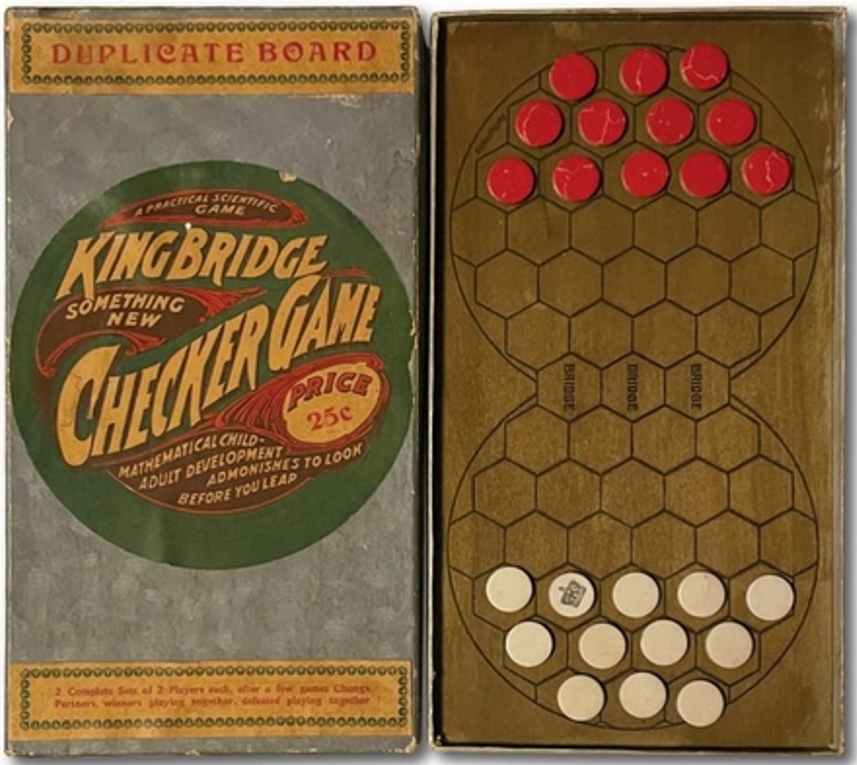
A bit earlier, in 1914, Hervey Dexter Thatcher submitted patent US1106991 for a King Bridge Checker Game, also using a hexagonal grid:

In this game there is a middle three hex bridge, and when a piece crosses it, it is promoted to 'King'. This game was published as we can see in the next pictures,


Kingbridge, AGPI Quarterly volume 7 [4]
 
a modern edition of Kingbridge

We can still step back 20 years, for a game by J. F. Beaman in 1894, described in US Patent 529582:


This is a proper Checkers game. So, our first 19th century hit! 

Another hexagonal checkers was patented by Charles E. Duryea in 1888 (patent US384195):


Can we go further back? Yes, here's US Patent 259695 by John F. Kingwill from 1882:


This (unnamed) game is basically a Checkers for three players. So, we have already some 19th century Checkers games! At BGG it was named Hexadraughts.

For the oldest entry, Ralf Gering mentioned a book by J. G. Lallement, Les Quatre Jeux de Dames from 1802 (which had a 2023 reprint),

If we zoom in the boards:

we notice the triangular/hexagonal nature of the connections between the board spaces!

So, after all, the idea did not have to wait for the Seventies!


The Damex solution for figure 2, from the J&S puzzle:

Apr 3, 2025

DIY Draughts

Do-it-yourself draughts, or Dames en Kit, is a c.1890 game by Walter Sanders,


diagrams from Jeux Stratègie's page

Rules. Each player has ten pieces and 20 tiles (one light and one dark set).

First phase: On each turn, each player places (a) a friendly piece on an empty same-color tile, (b) a friendly tile at the side of another already placed tile, (c) or both.

Second phase: When all pieces and tiles are placed, pieces are allowed to move to any adjacent empty tile of its color (including diagonals). 

However, in both phases pieces also have the option to capture. Pieces capture by jumping one or more consecutive enemy pieces, assuming there is an immediate empty tile of its color to end its move.

Captures are multiple, i.e., after a capture, the player may continue capturing with the same piece. And, like Checkers, captures are mandatory (if there are several options, the player can choose which). Captures are mandatory in both phases.

  • Notice that it is possible to place a tile, opening a capture option, that must be executed in that same turn. However, even if it is possible to place a tile in these conditions, players might choose not to.

Wins the player that captures or blocks all enemy pieces. If the interactions between pieces are no longer possible, wins the player with more moving pieces (blocked pieces do not count). Otherwise, the game is a draw.

Example: in this diagram, players cannot interact with each other. So, Black wins since he has two moving pieces against just one moving white piece.

The game appeared at Roger Millington's Games and Puzzles for Addicts (1979),


The game also appeared in Jeux et Stratègie #42 in 1986: