Showing posts with label rotating pieces. Show all posts

Mar 9, 2026

Les Crocs

Les Croks is an uncredited game that appears in Patrick Carpentier rule's collection. Unfortunately, the document is very sparse with information. The only date we can deduce is that the game is older than 1995-2000, the years where the collection was written.

The game is played on an initially empty 6x6 board. Each player has ten pieces (les croks, i.e., the fangs) all marked with a direction (e.g., an arrow).

Rules:

  • In a first phase, players take turns dropping a friendly piece on an empty square. 
    • Here's a board example after the end of this phase:
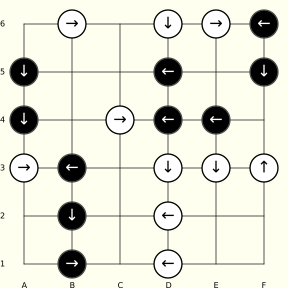
  • In the second phase, each player picks a friendly piece and can either:
    • move it to an adjacent empty square
    • move it twice in its forward direction
    • rotate it one quarter left or right
    • capture by replacement in its forward direction, unless the enemy piece is faced towards it
      • in the previous board, d6 can capture d5, but e6 and f7 cannot capture each other
  • Wins the player that captures all enemy pieces

There is a related game at the same collection, quite probably by the same unnamed author, called La Saga des Croks.

  • Here players only drop six pieces each, the other four stay in reserve.
  • The capture is changed to emulate reproduction: it is only possible to attack from behind.
    • The 'jumped-over' crok is not removed from the game. 
    • On the next turn, the attacking crok slides to an adjacent orthogonal empty square without changing orientation, and the player places a new crok from the reserve on any empty square. 
    • This new Crok must not be in a 'capture' position.
  • Wins the player that drops on the board his four pieces initially in reserve.

This second game was also described at Jeux et Stratègie #28 by Michel Brassinne:

Feb 24, 2026

Connex'Oh

Connex'Oh, aka Connexion, is a 1992 game by Sébastien Sjoholm, and published by Carlit.

The game is played on a 6x6 board. There are 36 tiles each divided into a dark triangle and a light triangle, and each player owns six pieces of his color. 

All tiles and pieces are initially placed as in the following diagram:

 Rules:

  • On his turn, each player can either:
    • Slide a friendly piece along a path made of empty adjacent triangles of the same color (two triangles are connected if they share one edge)
      • note: the moving piece cannot jump over other pieces, nor stop on an occupied triangle
    • Rotate a tile, whether it has pieces on it or not, by a quarter-turn or half-turn in either direction
  • If the rotated tile made new connections of the player's color, then neither one of these tiles can be rotated next
    • The game has a red token to identify the last rotated tile (cf. next picture) and its adjacent connections


  • Wins the player that moves his army out of the board from to the player's opposite side
    • To exit a piece from the game, the path it is on must be connected to the opposite side of the board; this requires the last triangle of the path to touch the edge of the game frame
    • Once a path is connected to the exit, all pieces on that path are immediately removed from the game without waiting for the next turn. This rule applies regardless of which player connected the path.
      • If a tile rotation causes both last pieces of both players to exit the board, the player that rotated the tile loses the game.

The rule of any number of pieces immediately leaving the game when a path is open to the board's edge, seems a way to allow the game to quickly converge to its end, but at the cost of loss of uniformity: it is a rule quite different in nature with regards to the regular move of just one piece per turn.

There is a 4x4 version of this game named Connexo published in 1995.

Jan 4, 2026

Deflections

Deflections is a 1985 game by Nik Sewell, published at Pentagram Games.


the centerpiece is the energy gun that shoots projectiles 

The game uses projectiles that move through the board, reflecting on different types of walls. These projectiles keep increasing in numbers, until one player is unable to escape thus losing the game.

 the different types of pieces and shields 

Here are the original rules (click to expand) explaining the rather convoluted rules of projectile movement.

This seems like a game more appropriate to be played on a computer. Updating many projectiles with difficult update rules is a recipe to constantly create invalid positions.


Feb 7, 2025

Tac-Tic-Turn

Tac-Tic-Turn is a 1987 game by Ned Strongin, published at IRWIN Games.

This is a variant of Tic-Tac-Toe played with nine 2x2 pieces that can be picked and rotated back.

Rules:

  • On his turn the player either:
    • drops a friendly piece on an empty square
    • rotates a 2x2 grid by 90º degrees
  • Wins the player that make a 4, or longer, in-a-row

The game had a review on GAMES #99,

§

Yasuhiro Jisai mentions that a variant of this game is marketed in Japan as Pitagoras, and includes a custodian capture for pair of pieces (like in Pente).

I went searching (ピタゴラスゲーム) and found this page where it is said: 相手の駒2個を自分の駒で挟むと取ることができます(1個を挟んでも取れません)[You can capture your opponent's pieces by sandwiching two of them between your own pieces. (You cannot capture by sandwiching just one piece.)]

This game comes with more pieces (which makes sense, given that captures are allowed),

Otherwise, having just six pieces, the captured pieces should be returned to the respective player's reserve.

Some comments from the mentioned page:

You know, I think this is quite a brilliant game. If you focus too much on lining up pieces, you'll get captured. But if you only think about capturing or blocking your opponent, you might overlook the rotation mechanic. And predicting how the board will change after a rotation is really tricky!"

Yuki-Onna highly praised the game, saying that constantly considering the effects of "sandwiching," "lining up," and "rotating" makes it excellent for training flexible thinking and multi-angle strategy planning.

Dec 18, 2024

Octiles

 A Dale Walton's game from 1984 published by Kadon.

Each player starts with five counters on the initial positions. There are also 18 tiles,

all eighteen tiles

Each player must move their counters to the circles on the other side of the board.

At the beginning the board is empty, and there are no paths to travel. The tiles are shuffled and stacked.

On his turn, 

  1. a player takes the top tile from the stack and places it on the board (adjacent to one of her pieces). The tile may replace an existing tile, which goes to the bottom of the stack.
  2. then the player moves one of his pieces over that tile, and eventually others, travelling thru a connected path. The path must end in an empty middle circle. Pieces cannot stop at the adversary final circles (i.e., their initial positions for a two player game).

When all tiles are used, all remaining moves will imply a tile replacement (the removed tile is then used by the next player).

Notice that when paths cross, that means bridges not road blocks. Paths can also follow the paths printed onboard.

When a piece reaches one of its final circles, it can no longer move. 

A player can pass, but it is illegal to have two passes in a row.


@ boardgamegeek