Jan 1, 2026
Apr 7, 2025
Dec 31, 2024
Dec 15, 2024
An old abstract game
Here are the relevant pages:

A nice discovery!
By
João Neto
at
08:13
Labels:
art and history,
older games
0
comments
Dec 2, 2020
A Game is Born
Inside my website World of Abstract Games, there is one page dedicated to Checkers variants. It includes regional rulesets and several other more recent inventions. Around 2001 or 2002 I included another one that I called "Board Draughts" with the following text:
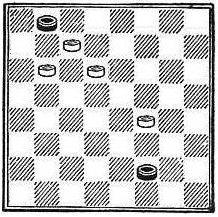
In Board Draughts, each player also starts with 8 stones of the first two rows. Stones cannot capture and just move and jump forward. The goal is to move all stones to the last row (where they are removed from board). Wins the player with no stones left. I don't have information about if jumping is mandatory, but I would guess that it is.
The game rules were copied from the rule's book of a 200 pack game that I had bought several years before,
Of course, 18 years passed and I had completely forgot all about this.
Last November, Ralf Gering sent me an email asking for more details about Board Draughts. He had noticed that the rules, as stated, were not complete. It seemed that [Ralf's Words],
jumping must be mandatory, otherwise it would be just too easy to block the opponent's stones. Which leads to another question: What do you do if your stones are blocked, which can still happen (albeit rarely)? In my opinion the player who is blocked should lose the game (as in "normal" draughts), which would add another strategic layer to the game.
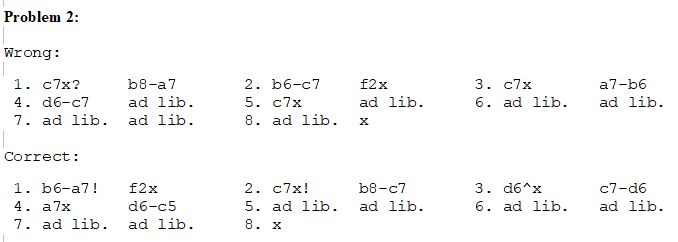
I agreed and included that on the ruleset. Ralf also gave a puzzle for this adapted game,
...and asked about the source of the original rules. I really didn't remember, but he was able to found some old email where I had mentioned the 200 pack game. I check it and indeed found the original text (in Portuguese),
Here there is also a Go-like variant where a group of surrounded checkers are captured and removed from the board. But at the time I didn't add it to the checkers page.
Anyway, I sent this information to Ralf and he was able to found a 1998 German edition called "200 Spiele: Viele Spiele für die ganze Familie", published by Peri-Spiele, an Austrian game business.
with the same game collection.
Ralf then commented,
Your game is actually called Halma-Dame in German! It was described by Erwin Glonnegger and Walter Diem in "Das große Ravensburger Spielebuch" (1974) [They also describe Blockade (=Bloqueio) just before they describe Halma-Dame!], by Hajo Bücken and Dirk Hanneforth in "Klassische Spiele ganz neu" (1990) and by Theo Hartogh in "Alte Brettspiele neu entdeckt: Mühle, Dame, Halma" (1999). The Portuguese translation is, however, misleading and (partly) outright wrong. According to the German sources pieces are allowed to leap over opponent's pieces, but that's not mandatory. The object of the game is to occupy the two farthest ranks that is the start position of the opponent. Pieces are never removed from the board. Nothing is said about blockades in the German rules.
So, my initial attempt to make sense of the Portuguese text, resulted in a (partially specified) new checkers game. I changed the checkers webpage to reflect this.
This is a small example of what I think is an important effect in the history of board games. Some regional variants, even new games, could have been created due to misunderstandings between people from different lands, communicating with difficulty without a proper shared language. Others might be born from reading underspecified rules or bad translations from books describing games. These misunderstandings produce ambiguity when trying to play the game afterwards, within your own family or community, and there is the need to create patches to make the game playable again. A bit like mutation in evolution.
By
João Neto
at
13:41
Labels:
art and history,
new games,
old games
0
comments
Mar 1, 2013
Colorito
Colorito is a 19th century game. Boardgamegeek has the following description:
Each player has 20 numbered pieces / counters of two colours (blue & red or brown & yellow), which are put on the two first rows of a 10×10 grid of octagons (topologically similar to squares, but without the diagonal adjacency). The fields of these rows are numbered from 1 - 20, so each counter has its definite starting place, making one complete row of either colour.
The spaces of the central six rows are coloured according to the counters, either red, blue, yellow or brown, and build up a regular pattern. Counters can step one space, jump across one other piece (also more than once during a turn) when landing eventually on a space of its own colour or doing a step plus a jump move in this order in a turn.
Aim of the game is to get the pieces on the opposite side onto the octagon with the corresponding number (similar to Salta, which maybe adopted this idea from Colorito).
This game was one of the favourites of Grand Duchess Anastasia Nikolaevna of Russia, mentioned in several letters/diaries about 1915.
Fred Horn sent me photos of two of his sets:
The rules, also from bgg:
There are three basic moves:
- the step, in which you can slide a counter in any direction into an adjacent octagon and stop there, provided that it is the same colour as the counter, or white (i.e. at the ends of the board);
- the jump, in which you can jump over any counters in any direction as long as the octagon you finally end up on is the same colour as the counter;
- the slide and jump, which combines both moves, meaning you can slide to any one adjacent octagon whatever the colour to start and then jump in the same move.
By
João Neto
at
09:40
Labels:
art and history,
old games
0
comments
Feb 22, 2013
The family of Foxes and Geese
The Fox & Geese family is a big one. There are multiple variants from everywhere with different board topologies and different types of unequal armies. The following images came from http://hong.vlinden.com except when noted.
Here's a 1880s variant called Siege Game:
Another example with the same name from around 1900:
And with a hexagonal board:
Fred Horn sent me a beautiful variant called Avro Eigen Zender Spel:
More old boards in here.
By
João Neto
at
09:33
Labels:
art and history,
older games
0
comments
Mar 20, 2012
Board Games in Oriental Exposition
From an oriental art and culture exposition at Lisbon (it was a surprise visit, so I only had the camera from my cell phone)
There was a Xiang Qi:
By
João Neto
at
10:03
Labels:
art and history,
chess,
traditional games
4
comments
May 21, 2011
May 20, 2011
Chivalry
PLAYING SURFACE: The Chivalry board contains 176 squares of identical size. Ranks are rows of squares, numbered 1 through 16, running horizontally from one side of the board to the other. Files are columns of squares, lettered A through N, running vertically from one end of the board to the other. The squares of the board, with their actual Camelot designation used for game notation, from the bottom rank to the top rank, from the left-most file to the right-most file, are: G1, H1, D2, E2, F2, G2, H2, I2, J2, K2, C3, D3, E3, F3, G3, H3, I3, J3, K3, L3, B4, C4, D4, E4, F4, G4, H4, I4, J4, K4, L4, M4, A5, B5, C5, D5, E5, F5, G5, H5, I5, J5, K5, L5, M5, N5, A6, B6, C6, D6, E6, F6, G6, H6, I6, J6, K6, L6, M6, N6, A7, B7, C7, D7, E7, F7, G7, H7, I7, J7, K7, L7, M7, N7, A8, B8, C8, D8, E8, F8, G8, H8, I8, J8, K8, L8, M8, N8, A9, B9, C9, D9, E9, F9, G9, H9, I9, J9, K9, L9, M9, N9, A10, B10, C10, D10, E10, F10, G10, H10, I10, J10, K10, L10, M10, N10, A11, B11, C11, D11, E11, F11, G11, H11, I11, J11, K11, L11, M11, N11, A12, B12, C12, D12, E12, F12, G12, H12, I12, J12, K12, L12, M12, N12, B13, C13, D13, E13, F13, G13, H13, I13, J13, K13, L13, M13, C14, D14, E14, F14, G14, H14, I14, J14, K14, L14, D15, E15, F15, G15, H15, I15, J15, K15, G16, H16. White’s Castle is composed of two Castle Squares G1 and H1, and Black’s Castle is composed of two Castle Squares G16 and H16.
PIECES: Each player begins the game with 20 pieces: eight Knights and 12 Men. The starting positions are: White Knights on C6, D6, K6, L6, C7, D7, K7, and L7, White Men on E6, E7, F6, F7, G6, G7, H6, H7, I6, I7, J6, and J7, Black Knights on C10, D10, K10, L10, C11, D11, K11, and L11, and Black Men on E10, E11, F10, F11, G10, G11, H10, H11, I10, I11, J10, and J11.
THE PLAIN MOVE: A piece (either Knight or Man) may move one square in any direction (horizontally, vertically, or diagonally) to any adjoining unoccupied square. This move is called a Plain Move.
THE CANTER: A piece (either Knight or Man) may leap in any direction (horizontally, vertically, or diagonally) over a friendly piece (either Knight or Man) that occupies an adjoining square, provided that there is an unoccupied square immediately beyond it in a direct line onto which the leap may be made. This move is called a Canter. Pieces cantered over are not removed from the board. A player may canter over more than one piece during the same move, but may not make a Canter that ends on the same square from which it began. When cantering over more than one piece in a move, the direction of the move may be varied after each Canter. A player is never compelled to canter, nor when cantering is he compelled to canter as far as possible.
THE JUMP: A piece (either Knight or Man) may leap in any direction (horizontally, vertically, or diagonally) over an opposing piece (either Knight or Man) that occupies an adjoining square, provided there is an unoccupied square immediately beyond it in a direct line onto which the leap may be made. This move is called a Jump. Each enemy piece jumped over is captured and immediately removed from the board. A player is obliged to jump if any one of his pieces is next to an exposed enemy piece. Having jumped over one enemy piece, the jumping must continue as a part of that same move if the player’s piece reaches a square next to another exposed enemy piece. When jumping over more than one piece, the direction of the move may be varied after each Jump. If presented with capturing alternatives, a player may choose which opposing piece to capture, and with which of his pieces to effect the capture. When compelled to jump, a player may, if he can, capture by a Knight’s Charge instead. The only situation in which a player may ignore his obligation to jump is when, on his previous move, he has jumped one of his pieces over an opponent's piece into his own castle, ending his turn there, and must, on his next turn, immediately move that piece out from his castle.
THE KNIGHT’S CHARGE: A Knight (only) may combine a Canter and a Jump in a single move, called a Knight’s Charge. A Knight’s Charge must follow the order of first the Canter(s) and last the Jump(s). A Knight is never obliged to make a Knight's Charge. When cantering over more than one piece during the cantering portion of a Knight’s Charge, the direction of the move may be varied after each Canter. If the Canter of a Knight brings it next to an enemy piece that can be jumped, it must do so, unless by a different route later in that same move it captures one or more enemy pieces elsewhere. During a Knight's Charge, the directions of the last Canter and first Jump need not be the same. Having jumped over one enemy piece during the jumping portion of a Knight’s Charge, the jumping must continue as a part of that same move if the player’s Knight reaches a square next to another exposed enemy piece. When jumping over more than one piece during the jumping portion of a Knight’s Charge, the direction of the move may be varied after each Jump.
NOTATION: The Plain Move is indicated by the notation “-” placed between the starting square and the ending square, e.g., C8-D9. The Canter is indicated by the notation “-” placed between the starting square, landed upon intermediate squares (if any), and the ending square, e.g., E6-C8-A8. The Jump is indicated by the notation “x” placed between the starting square, landed upon intermediate squares (if any), and the ending square, e.g., H4xJ4xL6. The Knight’s Charge is indicated by the notation “-” placed between the beginning square of the cantering portion, landed upon intermediate squares (if any), and the ending square of the cantering portion, and the notation “x” placed between the ending square of the cantering portion (the beginning square of the jumping portion), landed upon intermediate squares (if any), and the ending square of the jumping portion, e.g., F6-F8-H8xH10xJ12.
OBJECT: The game is won if a player moves any two of his pieces (Knights and/or Men) into his opponent’s castle. Or, the game is won if a player captures all of his opponent’s pieces, and has two or more of his own pieces left. Or, the game is won if a player has two or more pieces, and his opponent is unable to make a legal move.
DRAWN GAME: The game is drawn if both players have no more than one piece left.
PLAYER’S OWN CASTLE: A player may not plain-move or canter one of his pieces (Knight or Man) into his own castle. If an enemy piece reaches a square adjacent to his own castle, a player may jump, or make the jumping portion of a Knight’s Charge, over that enemy piece into his own castle. A player may not, during the cantering portion of a Knight's Charge, move his Knight into his own castle. If a player jumps over an opponent's piece into his own castle, and the player’s piece is then next to an exposed enemy piece, the jumping must continue (out of his own castle) as part of that same move. A player who has jumped one of his pieces over an opponent's piece into his own castle, and in so doing was unable to continue the jumping out of his own castle as part of that same move, must, on his next turn to move, immediately move that piece out from his own castle, with no exception. A player moving one of his pieces out from his own castle must jump out, if possible, instead of plain-moving or cantering out. If a player has the opportunity to jump out from his own castle, he may, if he can, satisfy the obligation to capture by means of moving out with a Knight's Charge instead.
OPPONENT’S CASTLE: A piece that has entered his opponent’s castle cannot come out, but is allowed to move from one castle square to the other (designated a castle move). A player is limited to two castle moves during a game.
ILLEGAL MOVES: A player who makes an illegal move must retract that move and make a legal move. If the mistake is only noticed later on, the game must be restarted from the position in which the error occurred.
By
João Neto
at
09:30
Labels:
art and history,
older games
0
comments
May 6, 2010
Three old Knight games
At Michel Boutin presentation in the BGS, he mentioned a lot of 19th century board games that were patented in France, UK, Germany and in the US (and most already forgotten). Here are three related games using the Chess Knight, grouped together in a package called Rampant Knights.
These are the board (click to augment), [source]
These are the rules:
The next pages from Hoyle's Rules of Games talk about these games:
He also mentioned a board game called "Jeu du Congo" (Game of the Congo) with a hexagonal board:
which was re-edited by Moulin in the French book Jeux de pions d’aujourd'hui. The rules can be found at issue 8 (Winter 2001) of the Abstract Games Magazine.
[January 2025 update] Check also AGPI Quarterly, volume 1 [3] (2017).
By
João Neto
at
10:14
Labels:
art and history,
old games
0
comments
May 5, 2010
The Game
Fred Horn showed me a picture of an old 1970/80's abstract game called "The Game",
He mentioned the rules orally, as he remembered:
The board starts empty and each piece (each player has five) enters in the player's corner.
On each turn, each player enters a piece off board or moves one friendly piece.
A piece moves [up to?] five cells in orthogonal directions with, at most, two changes of direction [no jumps allowed, it seems].
One piece may land in top of another. The pieces not in the top of a stack become blocked.
A stack can have, at most, three pieces. When a stack of size three is made, the piece in minority is captured.
When all the player's five pieces are on the board, the player cannot stop a friendly piece in his own corner (but it can move the piece thru it during the move sequence).
Wins the player that moves one of his pieces to the enemy's corner.
Any extra information about this game is appreciated.
Addendum: I found more about this one:
By
João Neto
at
19:09
Labels:
art and history
0
comments
Games @ BGS 2010
In the Board Games Colloquium (BGS) it is always easy to find new abstract boards and ideas about games. Let me give a sample of this year, in Paris:
Herein you can see a game from Fred Horn, which basically can be seen as a Mancala kit.
These squares can be placed in any order the players like and every mancala board can be built this way. Of course, this game material can be used into many other types of games.
Here you can see Fred Horn (in the left) playing Fianco, another of his games:
A very interesting game is Nonaga, a 2008 invention by Víktor Bautista i Roca:
Visually, this reminds Zèrtz, but in this case, we have a pattern game and the board only changes shape (it does not decrease in size as in Zèrtz). More info here.
By
João Neto
at
11:43
Labels:
art and history,
new games
0
comments
May 1, 2010
Ancient Board Games @ The Louvre
Here are some nice examples of race games from Ancient Egypt:
This was the text related to this game:
The obscure Mehen:
And the more known Senet (at least the text said it was Senet, it seems a version, half-way to the game of Ur):
And finally some old, old dice:
By
João Neto
at
17:07
Labels:
art and history,
older games,
traditional games
0
comments
May 1, 2007
Board Games Studies 2007 (part 3: The Spielmuseum)
The game museum, near Vienna, is a project from Dagmar de Cassan and her husband. Nowadays, it consists of thousands of games that are being archived and cataloged in a digital database. Let's hope they can solve the space problem so that people can consult and play many of these board games.
By
João Neto
at
09:22
Labels:
art and history
1 comments