Hex-Nut, and the boardless effect
Hex Nut is a 2001 game by Luke Miratrix, published at Pair-of-Dice Games.

The game has no board. There are two sets of ten hexes, one per player.
The players, on their turn, can either:
a) Drop a new hex that must be connected to more enemy hexes than friendly ones.
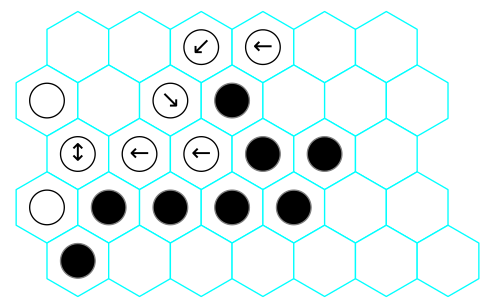
In the next diagram, the marked hexes are the legal moves for White to drop a new piece:
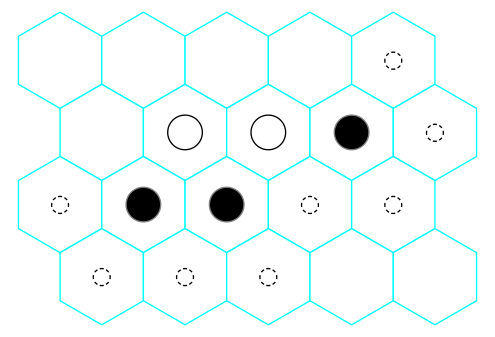
notice that the piece is the entire hex,
not just the black or white circle
(the empty hexes don't exist in the playing arena)
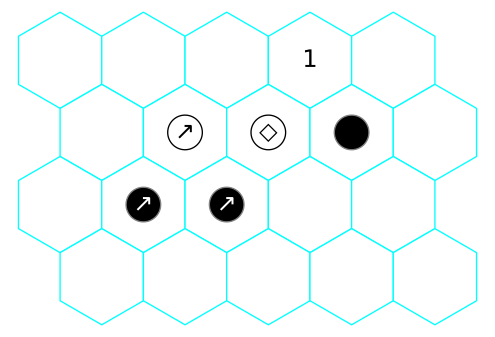
b) Move a friendly hex to the next edge of an adjacent hex (of either color). When the hex moves, if there's a group of hexes that would become separated from the rest of the pieces, then that group moves in tandem.
In the next diagram, White moves to [1] taking the three sized group with it,
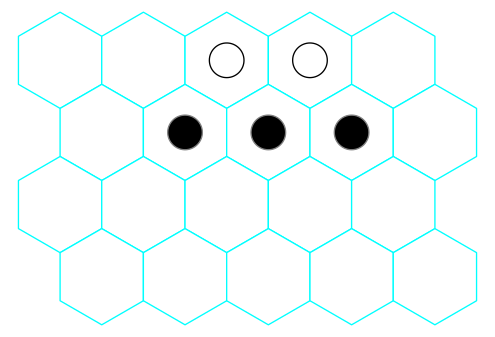
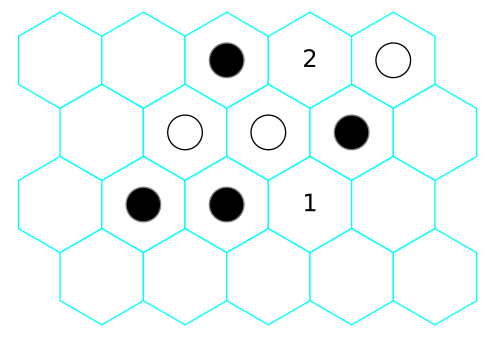
Moving a hex is only possible if it can be freely moved around the surface. If a hex is surrounded by enough pieces, and moving it would imply moving over other hexes, then that hex is locked in.
In the next example, the middle white hex cannot move to either [1] or [2] since there's not enough space to move it freely.
Wins the player that makes a chain of eight or more friendly hexes. Notice that this is not a connected group, a chain is a sequence of pieces where each hex is crossed only once.
In the next diagram we see two groups of eight hexes, but the White is not a sequence of eight pieces, since there's a branch at the left, implying that one of those stones cannot be counted.
A tip from the official rules:
The main thing I tell people, but which they rarely follow is: never split your pieces! If your pieces get divided, and your opponents do not, then you have lost. Consider if you have three pieces separate from your main clump. You cannot win unless they rejoin, and in the process of rejoining, they always cause a spot where your opponent can extend. In fact, once this happens to you, you should resign.
I find it interesting the boardless feature of Hex Nut. The shape of the game is built during the match; there's no restriction except for the pieces' shape.
Trax is perhaps the most classic boardless game, a tile-oriented game where players try to make a loop or a long enough line,

Trax has lots of resources, check traxgame.com for more information.
Hive, from 2001, is another boardless successful game. Other examples are Six, Ringo, Bermude, Pent-Up, Cubeo, Kaliko, Exxit, and John Conway's Sprouts.


GAMES magazine #39
I would like to mention Cameron Browne who designed some visually stunning boardless games, like Mambo, a territorial/capturing game:

check his website for more great examples.
Labels:
boardless,
old games,
tile games
 0
comments


