Showing posts with label moku. Show all posts

Oct 23, 2026

Shove Off

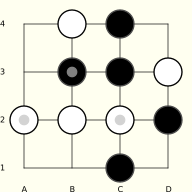
Shove Off is a 1984 game by Hank Atkins, published at Ideal.

The game is played on a 4x4 board. Each player has eight pieces, and there's also 16 neutral pieces.

Rules:

  • Initially players place all 16 neutral pieces on the board
  • On her turn, the player adds a friendly stone at the board's edge, by pushing all pieces on that row or column (so, the last pieces is pushed off the board)
    • however, it is illegal to push off an opponent's piece
    • if the player does not have a friendly piece to push (all eight pieces are on the board), then she uses one neutral piece instead
  • Wins the player that makes a 4 in-a-row orthogonally or diagonally

The moku ludeme is quite common, and the pushing element is not original (cf. Overboard). What is different here is that players are unable to push off enemy pieces.

Here are low quality pics of the original rules:

§

A similar idea was proposed independently by Steve Bateman, when he posted at rec.games-abstract, in Aug 25, 1995. Here's the message (slighty edited):

I was looking through the games on Richard's PBeM server when I had an idea for a new game, called "Push". I have attached a copy of the rules, and would appreciate any feedback on the game, especially on:
1. Has anyone ever heard of, encountered, played a game like this before?
2. Is the game concept OK - would you want to play a game?
3. How well does it work in two-player, three-player or four-player mode?

The Game of Push
================

Description
-----------
Push is a two-, three- or four-player game played on an 8x8 square board, each player playing with counters of a single color. The aim of the game is to have a line of your color appear on the board.

Rules
-----
1) The board is an 8x8 square, and is empty at the start of the game.

2) The game may be played by two, three or four players.

3) Each player has an unlimited supply of counters of a single color. With two players, player one plays white, player two plays black. With three players, the third player plays red. With four players, the fourth player plays green.

4) Play begins with player one, and proceeds in turn through player(s) two, three and four, then back to one again (and so on).

5) Each player must make one move on their turn (there is NO passing).

6) A move consists of "pushing" a counter onto the board from an edge position. The push may be horizontal, vertical or diagonal, but must be away from the pushing edge toward another edge of the board (so from the top, the push can be toward the right, the bottom or the left - SE, S, or SW on a compass - but cannot be parallel to the edge - E, W - nor away from any other edge - NE, N, NW).

7) "Pushing" a counter onto the board may move other counters already on the board as follows:
  a) If the edge position is empty, then no other counters are moved.
  b) If the edge position is not empty, then all connected counters in the
     direction of the push are moved one square in that direction.
  c) Only connected counters are affected by the push.

8) Any counter pushed off the edge of the board during a move is returned to the player playing that color (there are no captures).

9) After each move, the board is examined for lines (horizontal, vertical or diagonal) of a single color. With two players, the lines must be five counters long, with three or four players, the lines must be four counters long. A player wins when a line of their color appears on the board, as follows:

a) If a player makes a line of their color as a result of their move, that player wins.
b) If a line of another other color is made as a result of the move, then the player playing that color wins.
c) If lines of two or more colors are made at the same time, then the player whose turn comes next wins, starting with the player who made the most recent move (so if player one moves, and makes two lines, one for player three and one for player four, player three wins - players one and two do not have a
line so do not win).

Sep 15, 2026

Link-Up and Nebula

Link-Up is a 1972 uncredited game, published at American Greeting Co.


there are two unavailable positions, at d4 and e6

Each player has 31 tiles of three different type (check below). The goal is to score points by making lines of connecting friendly lines, either orthogonally or diagonally.

The rules:

The different tiles provide different threats of making points, which seems an interesting idea. However, it is doubtful that players are able to score six or more lines in a row, given the board's size.

don't know why there are two unavailable placements,
 but I assume there's a good reason


 §

A similar n in-a-row game, where larger sequences get larger scores, is 1976's Nebula.

Jun 12, 2026

Gomoku Clones

Commercializing traditional games, which have no copyright, is at the same time less expensive because of the lack of copyright, but also a homage to the public commons and to old cultural traditions.

Gomoku is a traditional game with simple rules, and yet it is deep enough to be quite challenging and highly replayable. It's no wonder that so many games have been marketed based on the moku ludeme.

This post refers to some less known older games that are a plain rebranding of Gomoku.

Peg A Ro 

A 1920s game published in England. It comes with a 16x16 board and four sets of pieces (around 27 pegs per color) so that it can be played between two and four players.


Spoil Five

Published also in the 1920s by Chad Valley Co.

This game comes with a 14x11 board and with four colors. Each player only gets 16 pieces for each color, which is not enough to play the game (even if each player uses two colors). I wonder if even a 4 in-a-row would be easy to do in a match with four players.


Notice that the last suggested game in this ruleset in none other than the Game of NIM (in the misère version), one of the seminal games that started Combinatorial Game Theory.

Peg'ity

Another clone is Peg'ity from 1925, from Parker Brothers,


In the 1953 edition, there is the following supplement with three extra games/puzzles:


This last one is again misère NIM.

Quintro

Quintro is a 1935 version of Gomoku from Spear's Games.


Quinio

Quinio is a 1956 uncredited Gomoku game, published by Jumbo:


And a bonus, 1957's Chek-ro which is Pente before Pente:


Jun 5, 2026

Line-Ups

Line-Ups is a 1979 game by Phil Orbanes, published at GAMES magazine #11.

The rules came with two 12x12 boards to be played in the magazine itself using pencils (it was part of the recurring Pencilwise section).

Line-Ups is thus a pencil and paper game, and a curious mix of moku and scoring ludemes.

Apr 22, 2026

Mastergame

Mastergame is 1982 uncredited game published by Invicta Games.

It is played on a 8x8 board where squares are marked by card suits. Each player has eight pieces also marked with suits (two pieces per suit).

Rules (adjacencies are orthogonal and diagonal):

  • The pieces are placed initially on the board (see review below)
  • On his turn, the player moves one friendly piece to any adjacent empty square
    • However, a piece cannot move to squares marked with their own suit
  • Wins the player that makes a 4 in-a-row with friendly pieces but all with different suits

There's the saying that "a theory should be as simple as possible, but not simpler". I'm afraid the latter is the case with Mastergame. Anyway, the square-piece restriction is a nice touch, trying to make it a bit more difficult to make a 4 in-a-row with such mobile pieces.

This is a review from Science & Vie #781 (October 1982):

Mar 31, 2026

Pentana

Pentana is a 1978 game by Larry Yoos, published at Pentana Enterprises.

The game is a moku variant played on a 4x4 board, with four pieces per player.

Rules:

  • Initially, the pieces are placed on each player's first row
  • On his turn, the player moves a friendly piece to any adjacent empty square (orthogonally or diagonally)
  • Wins the player that makes a 4 in-a-row with his pieces (except at the row where his pieces begin) or by placing the pieces in the four board corners.

The game seems too simplistic to work properly. If a player places three pieces in a main diagonal (excluding the adversary row), the adversary only has one way to win, which is to make one column, and that column can easily be blocked by the player's fourth piece.

Not sure why the name has the root 'penta' in it, since that means five. Perhaps it as something to do with the success of Pente (published at 1977).

A game ad at Games #24:

Jan 26, 2026

The Game is Nirtz

The Game is Nirtz is a 1961 uncredited game, published by Ideal.

The game is played on a 8x8 board,


and each player has 10 pieces, marked 1 to 5 (each player has two of each).

This is a 7 in-a-row game (!) where pieces are not placed but moved. The number label determines the piece's moving range.

Here are the official rules: 


Besides the seven in-a-row requirement, the row must be orthogonal to the piece's initial setup (so, no diagonals also). The designer must have felt that leaving the direction to be decided would make the goal too easy to achieve. On first glance, it does not seem so, since making a seven in-a-row, especially on such a small board, is usually very hard if not impossible. 

However, the winning pattern can use the opponent's pieces, which is a quite original take on this genre. Also, the largest pieces are very flexible, since they can zig-zag while moving.

Jan 23, 2026

Caesars

Caesars is a 1980s uncredited game, published by Idéal Loisirs.

The game is played on a 4x4 board, where each player has a different set of eight Othello-like pieces.

The rules:

  • The board starts empty
  • On the first turn, the first player drops a friendly piece with either side facing up
  • On their remaining turns, each player:
    • Moves and flips one of their opponent's pieces (if no movement is possible, pass this step)
    • Then drops one friendly piece on an empty square, with either side facing up
  • Wins the player that makes a 3 in-a-row (orthogonally or diagonally) with friendly pieces with the same side, provided the adversary cannot break this line on their next move

When the board starts getting full, players will have less and less leverage to change the adversary position. On the other side, less pieces will get flipped, which might be bad for either player.

In the next position, Black to move. One possible option is to move white's d3-d4 and flip (in the corner, the piece is quite harmless) and place a piece at b1 with the 'ball' side. That means that if the adversary moves either b1 or c1, he can reply with a 3 in-a-row:

Here's a game description at Jeux et Stratègie #43:

Dec 14, 2025

Megiddo

Megiddo is 1985 game by Steve Baldwin, associated with several different publishers.

The board is made of six concentric rings under a central six-point start. There are 36 pieces of three different colors (the third color is for the three-player version):

  • Each player, on her turn, drops a friendly piece on an empty circle.
  • Captures are custodian: if a piece is dropped, and there are two enemy pieces and then a friendly piece, all in the same direction, then the two enemy pieces are captured, and replaced by two friendly pieces.
    • The allowed directions are (a) in the same circle, (b) in the same line, (c) making a spiral on concentric circles (cf. next example)

    • Captures can occur in multiple directions at the same time
    • Also, captures create a chain reaction: the new pieces that replace the captured ones might produce new captures, and so on. But notice that first all multiple captures must be executed before considering chain reactions.
    • Pieces are always captured in pairs.
  • Wins the player that either (a) captures six enemy stones, or (b) makes one of the three winning six-piece patterns, named radial, circular, and spiral:

The rules propose a multi-match game until one player reaches 36 points:

  • Winning with a winning pattern: 6 points
  • Any extra winning pattern: 12 points
  • Each captured piece: 1 point

The rules also mention a 'Cleopatra' variation: the typical custodian capture does not apply if a player drops a piece between two enemy pieces, rule which the game follows. In Cleopatra, dropping a piece inside will capture the pieces on the extremes:

Here are some tips from the original rules:

The game is a variant of Pente (which itself is an iteration of Gomoku-ninuki). The fact that there are three very different types of direction (radial, circular and spiral) removes clarity to the game. Unless players are attentive, they will miss captures and even winning patterns.

Unlike Pente, it is easy to start using pieces at the edge, which have the advantage of being harder to capture. I'm not sure if this is good or bad, but it is an important feature in this game. The tips mention 'taboo points', places where a player has a winning threat if the adversary plays there, which is something common in the moku family. Matches will converge into a cold phase, where the first player forced to play in one of those points, immediately loses the game.

A review on GAMES #67: