Showing posts with label older games. Show all posts

Sep 25, 2026

Triade and The Game of Pegpen

Pipopipette or Quadratini are Italian names (at least in the 1980s) for Dots and Boxes (invented by François Edouard Anatole Lucas in 1889). The game is quite well-known being, perhaps, the second most famous of the pencil and paper games after Tic-Tac-Toe.


there were even published games for Dots'n'Boxes

I'm mentioning the Italian name because I found at Pergioco, issue of July 1981, a curious variant of this game, called Triade. The game is played in the same grid and colors, but players are also able to connect diagonals.

Rules:

  • At his turn, a player makes a new connection between two corners of a square.
  • A player scores for each triangle with all three sides drawn by him
    • The value of the triangle is given by its area (e.g., the smallest triangles value 0.5 points)
    • Notice that after a move, several triangles can be closed
    • If a player scores, he does not play again (unlike Dots and Boxes)
  • When the game ends, wins the player with highest score (players may also decide a fixed value to achieve a win)

The original page with the game description:

An automatic translation of the Triade rules:

The game represents the triangular equivalent of Pipopipette, but adds to the game a greater richness of strategic themes, ultimately being more varied and interesting than its predecessor. Here too, the material consists of graph paper and two pens of different colors, and the game begins by defining a playing area. Players take turns making a move, which consists of drawing a line segment in two possible ways: either by retracing a side of any square or by drawing one of the two diagonals, always of a square of their choice.

Points are scored in the ways shown in the examples in Figure 2; from these it is clear that only triangles with all three sides of the same color score points, and they have a minimum size of half a square. In Triad, unlike Pipopipette, the move does not remain with the player who has "closed" triangles, but passes alternately from one to the other.

In this game it is possible that with a single move, multiple triangles can be closed.

In the example in Fig. 3, the player with the solid line, by drawing the segment A-B, simultaneously closes the triangles E-F-G (worth 4 points), A-C-E (worth 1 point), A-B-C (worth ½ point) and A-B-D (also worth ½ point), thus obtaining 6 points with a single move.

In Fig. 4 we see a diagram that shows the situation of a game already in progress; in this situation, if it were the turn of the player with the solid line, he could, by drawing the segment A-B, obtain 2 and ½ points; if instead it were the turn of the player with the dashed line, he could draw the segment A-B to take away this good opportunity from his opponent, or, if he wanted to score points, draw the segment C-D and obtain 3 points.

Triad can be played until all possible moves are exhausted, but it is more fun and simpler to set a score to reach before the opponent.

§


The Game of Pegpen is a 1929 uncredited game, published at Stoll & Edwards Company.

This is also a variant of Dots and Boxes, but where instead of four moves to own a square, the players need eight moves (!)

The rules:

§ 

Another iteration of this concept is 1968's Squaresville by Cadaco Publisher.


The golden squares value two points for the player that surrounds them. Notice also that some walls are already placed, so the board does not start empty.

The rules:

Sep 4, 2026

Attacco

Attacco is a c.1900 game by George Howard Monks (the inventor of Halma), published by Adolf Sala.

It is played in a 11x17 board with the following markers,

Each player has 22 pieces that start at the dotted squares. The filled square is the player's stronghold.

Rules:

  • On his turn, a player selects one friendly piece and either:
    • moves to an adjacent light-colored square (orthogonally or diagonally)
    • jumps over any piece landing on the immediate next square, that must be empty and light-colored
      • if the jump is over an opponent piece, this piece is captured
      • jumps can be multiple but are not mandatory, and the player may stop jumping whenever he wants
  • Dark squares are walls that cannot be moved in or jumped over
  • Wins the player that moves a piece into the opponent's stronghold, or captures all enemy pieces

There is a (possibly less interesting) variant of the game [1], that only allows jumps over enemy pieces.

[1] Fred Horn - Attacco, AGPI Quarterly 8 [1] (2024)

Aug 21, 2026

Les Conspirateurs

Les Conspirateurs is a game that appears to be from late 18th century France.

The game is played on a 17x17 board initially empty, with the following markings:

Each player has twenty pieces that start off board. The 5x9 rectangle is a safe area. The 39 gray squares at the board edges are the sanctuaries.

The rules:

  • First, both players take turns to drop their stones on empty squares inside the safe area
  • Then, at each turn, each player selects a friendly piece and either:
    • moves it to an adjacent (orthogonal or diagonal) empty square
    • jumps over an adjacent piece of any color to the opposite empty square; if other jumps are available, the stone can continue to jump in any direction (there are no captures, and jumping is not mandatory)
  • A player wins when all his twenty stones are in twenty of the available sanctuaries.

The details about the game originate from R.C. Bell in his The Boardgame Book, pg 129:

Bell seems quite unsure about the game's origins, so this information might be wrong. As it is, it would make it 100 years older than Halma, the well-known 19th century English game which uses the same types of ludemes. The only information besides the rules, is that Bell acknowledges Matthew Wurr as an artist, regarding Les Conspirateurs, which most probably means it was Wurr that drew the game images for this book. I also browsed the most probable books from the bibliography, without success.

In Discovering Old Board Games, a 1980 book also written by Bell, he states that the rules came «from a French text» translated by Miss Fiona Brookes. Unfortunately, nothing else is said.

I could not find any older sources that mention Les Conspirateurs. This is not a case where we don't know the rules of an older game. We do know the rules -- at least according to Bell -- the question is how old the game really is!

There is another reference I could not find online:

  • Michel Boutin, Jeu de pions, les conspirateurs, Les Cahiers de l'animation #21, Ceméa, January 1998.

A game full of mysteries!

Aug 7, 2026

Tricolor

Tricolor is a 1930 game by Maurice Kraitchik, and published at F.X. Schmid.

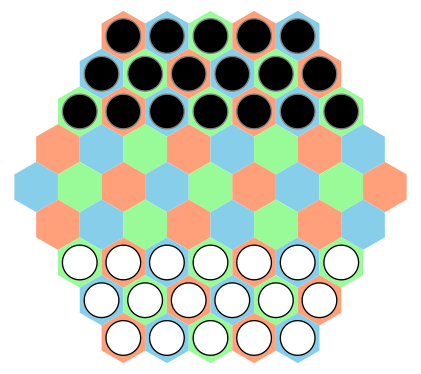
The game is played on a regular hexagonal board of size 5. The players have 18 pieces each that they place on their first three rows:

Definitions:

  • Pieces are stackable and can be made of mixed colors. The stack owner is given by the color of the top piece
  • The power of a stack is based on its size and the hex it is on
    • The base power is the number of friendly pieces in the stack (up to a maximum of three)
    • If the stack lies on yellow hex its power multiplies by 1; green multiplies by 2, red by 3
      • note: the hex colors used in the post's setup diagram are not the same, please check the board below
Rules:
  • On his turn, the player moves one friendly stack
  • A stack with N friendly pieces moves up to min(3,N) hexes in a single direction (no turns are allowed)
    • Stacks cannot jump over stacks (friend or foe) but can land on top of friendly stacks
    • A stack can split when moving, leaving the bottom part in the initial hex (the part that stays may change owner, depending on its top piece); the moving range of the top part is given by its number of friendly pieces
  • A less powerful enemy stack, in moving range, must be attacked (attacks take precedence to simple moves)
    • The attacker moves on top of the attacked
    • If the attacking stack is more than twice as powerful, the enemy pieces in the attacked stack are removed from the game (this is called killing)
    • If not, the enemy pieces stay on the stack, and the order of the pieces remains unchanged (this is called capturing)
    • If there are several attack options, the player decides which to execute
  • Wins the player that captures and/or kills all the enemy pieces, or stalemates the adversary.

There is a price to pay for stacks with more than three friendly pieces, since these stacks stop having more power after three pieces. The only advantage is the ability to split the stack and maintain more moving range. Not sure if this is worth the risk of having many pieces in the same stack. However, the rule makes sense, to prevent players to build a singleton stack with immense power.

Ralf Gering comments on BGG referring some tactics: 

  1. Force your opponent to capture on weak hexagons; 
  2. A war is won by sacrifices; 
  3. Invasions into enemy territory are more dangerous for the aggressor; 
  4. Be smart when you dismantle a big stack!

§

Tricolor is one of the oldest stacking abstract games, after Bashni  and Laska (which inspired Tricolor). It also has an option for three players (check original rules below).

Here is the first reference of the game on Kraitchik's 1930 book, Le Mathématique des Jeux (the following pages are from Dover's second edition, 1953),

Here's a review on Games & Puzzles #32: 

This is one of the first hexagonal board games with stacking pieces. 

I know only of one older example, and it is from US patent 437838, by Heinrich Sperl, that designed a game that was never commercialized (afaict) and, so, is quite obscure:


Jul 31, 2026

Jeux des Oies de Mathurin

Jeux des Oies de Mathurin is another game found at the Flicker account of patricia m:


photo by patricia m

Each player has eleven geese (owen by Mathurin) and the twin boards are the enclosures from which the players must make them exit.

Rules:

  • Each player places their eleven pieces on eleven squares of the corresponding color. The twelfth square remains empty to allow the pieces to move.
  • On her turn, a player either
    • moves a friendly piece to an empty diagonally adjacent square 
    • captures a friendly stone; pieces capture like Checkers, one piece diagonally jumps over another, landing on an empty square
  • Wins the player that first captures ten of his own geese 

Achieving the goal, thematically, means the geese were able to escape their cage.

The original rules state: jusqu’à ce qu’un des joueurs ait complètement débarrassé son enclos [...] des onze oies qui y étaient enfermées. That means the goal is to remove all eleven geese, but according to the rules, the last geese is alone and cannot be captured. I assumed that the goal is achieved after the tenth geese capture.

Here is the original text written in the board:

Ce jeu doit être joué par deux partenaires qui prennent l’un le damier et les pions rouges; l’autre le damier et les pions jaunes.

Les pions représentent les oies de Mathurin et les damiers les enclos d’où les joueurs les doivent faire sortir. Le but du jeu est d’arriver, par des combinaisons semblables à celles du jeu de dames à disposer ses pions de telle sorte et à les prendre de telle façon que le joueur puisse, en le moins de coups possible débarrasser son damier

Chacun des joueurs pose ses onze pions sur onze cases de la couleur correspondante. La douzième case doit rester libre pour l’évolution de ces pions.

Celui que le sort désigne pour commencer la partie bouge un pion de son damier ou en prend un; l’adversaire agit de même et à tour de rôle jusqu’à ce qu’un des joueurs ait complètement débarrassé son enclos — représenté par le damier — des onze oies qui y étaient enfermées.

Celui qui a le premier obtenu ce résultat est le gagnant

Les pions peuvent évoluer en avant et en arrière, mais seulement sur les cases de couleur et par la diagonale.

Jun 12, 2026

Gomoku Clones

Commercializing traditional games, which have no copyright, is at the same time less expensive because of the lack of copyright, but also a homage to the public commons and to old cultural traditions.

Gomoku is a traditional game with simple rules, and yet it is deep enough to be quite challenging and highly replayable. It's no wonder that so many games have been marketed based on the moku ludeme.

This post refers to some less known older games that are a plain rebranding of Gomoku.

Peg A Ro 

A 1920s game published in England. It comes with a 16x16 board and four sets of pieces (around 27 pegs per color) so that it can be played between two and four players.


Spoil Five

Published also in the 1920s by Chad Valley Co.

This game comes with a 14x11 board and with four colors. Each player only gets 16 pieces for each color, which is not enough to play the game (even if each player uses two colors). I wonder if even a 4 in-a-row would be easy to do in a match with four players.


Notice that the last suggested game in this ruleset in none other than the Game of NIM (in the misère version), one of the seminal games that started Combinatorial Game Theory.

Peg'ity

Another clone is Peg'ity from 1925, from Parker Brothers,


In the 1953 edition, there is the following supplement with three extra games/puzzles:


This last one is again misère NIM.

Quintro

Quintro is a 1935 version of Gomoku from Spear's Games.


Quinio

Quinio is a 1956 uncredited Gomoku game, published by Jumbo:


And a bonus, 1957's Chek-ro which is Pente before Pente:


May 22, 2026

Stax

Stax is a 1919 game by Chauncey H. Hatheway, published by the Stax Company.

The board and the company name are the only information at abstractstrategy.com/stax.html. Around 2006 I was able to find a bad digital copy of the rules.

Stax is a stacking game where each player has two types of pieces: the (twelve) Minors and the (twelve) Majors. The stacks can consist of pieces from both players, and its ownership is determined by its top piece. The goal is to capture or control (via stacking) all adversary pieces.

Here are the pictures, after my attempt to digitally improve them:


RULES FOR PLAYING STAX  
Copyright 1919 by Chauncey H. Hatheway  

The game is played on the diagonal only — never straight forward or straight backward, or to the sides.

THE PIECES  

Minor Pieces — The dark red and dark blue men. These men are known as "Minors," and can be moved diagonally forward only.  

Major Pieces — The light red and light blue men. These men are known as "Majors," and can be moved either diagonally forward or backwards.  

A Stack — Two or more men of either or both kinds, and of either or both colors, piled or stacked together. These "Stacks" are built up and torn down during the course of the game. The top man of a "Stack" controls all the men in the "Stack" underneath him, no matter what kind or color they are, and the "Stack" is moved diagonally as one piece from circle to circle as if the top man only were on the board. When the top man is a "Minor," the "Stack" is known as a "Minor Stack," and can be moved forward only. When the top man is a "Major," the "Stack" is known as a "Major Stack," and can be moved either diagonally forward or backwards.  

At the beginning of the game, the twelve dark red and twelve dark blue men or "Minors" only are used. The light red and light blue men or "Majors" are brought into action later on as described hereafter.  

THE GAME  

The game is played by two players; each player choosing a color and placing the Minor pieces of that color on the circles of the first three rows of the board directly in front of him. As noted above, these "Minors" can "Move" or "Capture" forward only.  

Whenever during the course of a game, a "Minor," either by a "Move" or a "Capture," reaches the last row of circles on the opposite side of the board, it must be immediately removed from the board by the player, and be replaced by a Major piece of the same color, and belonging to the same side. As noted above, these "Majors" can "Move" or "Capture" either forward or backwards.

Likewise, whenever a "Minor Stack" (i.e., a "Stack" having a Minor piece on top) reaches, either by a "Move" or a "Capture," the last row of circles on the opposite side of the board, the "Minor" on top must be immediately removed by the player, and a "Major" of the same color, and belonging to the same side, be placed in its stead on top of the "Stack." The "Stack" then becomes a "Major Stack," and can then "Move" or "Capture" either diagonally forward or backwards. Remember the top "Minor" only is exchanged—not the whole "Stack," nor any of the pieces (whether they be "Majors" or "Minors") which lie underneath.

In the above cases, care must be taken to always exchange the top "Minor" for a "Major," and not to place a "Major" on top of a "Minor" without removing the "Minor." Each player at all times must have twelve men on the board, and if at any time during the game he has more or less than twelve men, then some mistake has been made in the method of substituting "Majors" for "Minors" as outlined above, and if this mistake cannot be immediately rectified, the game should be discontinued and a new one commenced.

It should be especially noted that this exchange of Major for Minor pieces takes place only when a "Minor" reaches the last row on the opposite side of the board, and never at any other time. This is the only time during the game when a piece is ever removed from the board.

When a "Major," whether it be a single man or a "Major" on top of a "Stack," reaches the last row of circles on the opposite side of the board, no exchange of pieces is made, nor is another "Major" placed on top of it. Otherwise each player would soon have more than twelve men on the board.

The play is of two kinds — "Moving" and "Capturing."

A "Move" is made by advancing a piece diagonally to an adjoining vacant circle. A "Move" is the first play on each side, and is thereafter the regular play except when a "Capture" can be made.

A "Capture" can be made by either a single piece or by a "Stack," and must be made whenever possible. This occurs whenever one of the opposing pieces occupies a circle diagonally adjoining a circle on which his opponent's piece stands, and an adjacent vacant circle lies beyond.

The "Capture" of a single man is made in the following manner: The player whose turn it then is places his piece, whether it be a single man or a "Stack," on top of his opponent's man, and moves both as one piece to the vacant circle. The resulting piece, or "Stack," is then controlled by the top man, and is moved from circle to circle as if the top man only were on the board. The following diagram illustrates the method of "Capture" of a single man:

Note that Red has placed his man on top of Blue's and has removed the resulting piece or "Stack" to the vacant circle. This "Stack" is then controlled by Red for his man is on top, and is moved by him as a "Minor Stack" or a "Major Stack" according to the character of his piece which is on top.

Whenever, during the course of the game, an opposing "Stack" can be attacked by either an opponent's single man or by one of his "Stacks," it must be done in the following manner: The player, whose turn it then is, places his man or his "Stack" on top of the opposing "Stack" and "Captures" the top man ONLY of the opposing "Stack," leaving the remainder of the opposing "Stack" on the same circle on which it stood at the time of the "Capture." The remainder of the "Stack" then immediately becomes governed by the top man and is moved as if only the top man were on the board. If such top man is of different color from the man just removed from the "Stack" by the "Capture," then the "Stack" immediately changes hands, becoming a piece of the opposing side, and being moved by that side as a "Minor" or "Major Stack" according to the character of the top man which is on top. If the top man is of the same color as the top of this piece at which is on top. If the top man happened to be Blue, as is often the case, then this "Stack" would belong to Blue, and be moved by him as a "Minor" or "Major Stack" according to the character of his man which is on top. [...] The following diagram illustrates the method of attacking a "Stack"

Note that Blue has taken Red's man off the top of the opposing "Stack," and has carried it on the bottom of his "Stack" to the vacant circle. This leaves the remainder of the opposing "Stack" on the same circle on which it stood at the time of the "Capture." This "Stack" then belongs to Red for another of his men still remains on top, and is thereafter moved by him as a "Minor" or a "Major Stack" according to the character of his man which is on top. If after the "Capture", the top man happened to be Blue, as is often the case, then this "Stack" would belong to Blue, and be moved by him as a "Minor" or "Major Stack", according to the character of his man which is on top.

It should be especially remembered in "Capturing" that only a single man at a time can be taken. This is of course plain when a single man only is "Captured," but it equally follows when a "Stack" is attacked, for in the latter case the top man of the "Stack" only is "Captured," leaving the remainder of the "Stack" — whether it be only a single man (as is always the case when a "Stack" of two is attacked) or a "Stack" composed of several men — on the same circle it occupied at the time of the "Capture."

In any one turn of play a single "Major" or a "Major Stack" can never, after making one "Capture," return to the same circle from which it started that play by "Capturing" another man from the same opposing "Stack." In other words, an opposing "Stack" cannot be attacked twice in succession in the same turn of play.

A player must continue to "Capture" in one play as many of his opponent's single men or "Stacks" as is possible with the single exception that when a "Minor" or a "Minor Stack" reaches the last row of circles on the opposite side of the board, it must be immediately replaced by a "Major," and the play then ends. If the piece, however, be a "Major" or a "Major Stack," it must continue to make "Captures" as long as possible whether they take it into the last row or not.

Single men or "Stacks" belonging to one side can never be "Captured" by single men or "Stacks" belonging to the same side.

The game is won by one player "Capturing" all of his opponent's pieces or, in other words, by controlling all the "Stacks" on the board; or by blocking his opponent so that he cannot move.

HINTS ON PLAYING

The strategy of the game is for each side:  

1. To build up "Stacks" by having several of its own men (preferably "Majors") on top, and with them to wear down by "Capture" the weak "Stacks" of the opposing side.  

2. To imprison its opponent's men in "Stacks" which it controls and thus render them, for the time, being inactive.

A "Stack" with several of your opponent's men underneath and one of your men on top, is a weak piece and should be protected and used as a defense only, for your opponent by attacking it can "Capture" your piece on top and thus release his own men underneath. On the other hand, a "Stack" with several of your own men on top, or composed entirely of your men (especially if these men are all "Majors") is a strong piece and should be used to attack and wear down by "Capture" the weak "Stacks" of the opposing side.

When one side has a strong "Stack," it will often be found advantageous for him to move so as to force the opposing side to capture a man off the top of this "Stack" if by so doing he can, in the succeeding plays, "Capture" the controlling man off an opposing weak "Stack," and thus release his men which are imprisoned in this opposing "Stack."

During the first part of the game the play consists mostly of "Moves," "Captures," and "Recaptures" of the "Minors." Small "Stacks" are constantly being built up and torn down, and it is very seldom that a "Stack" of more than two men is built up at this stage of the game. The strategy which should first govern the game consists of maneuvering so as to "Capture" an opponent's main piece every man of yours which he "Captures," and to build up a "Stack" with two of your own pieces every time your opponent builds up a "Stack" of two of his pieces. As soon, however, as a "Minor" on each side reaches the last row of circles on the opposite side of the board, and is replaced by a "Major," the "Stacks" composed of three, four, five, or even more pieces begin to pile up rapidly, and as the game progresses the "Minors" gradually disappear from the board, so that towards the end of the game, if it be a hardly contested one, nearly all the men on the board will be "Majors."

In not only a few games will all of the twenty-four "Major" pieces furnished in the set be used. They are provided, however, in case the game is very close and they are all required. In such a game, of course, during the play every "Minor" has been retired from the board.

The STAX Company
Greenwich, Connecticut

May 15, 2026

Jeux des Grandes Manoeuvres

Jeux des Grandes Manoeuvres is another game found at the Flicker account of patricia m:

photo by patricia m

Each player has five pieces of infantry, four pieces of cavalry, and one piece of artillery.

Rules:

  • Initially, each player places his army on his side of the board: eight pieces in the first row, two in the second row. The cannon must be at the first row.
  • At each turn, each player moves one friendly piece:
    • An infantry can move one square sideways or forward (includes diagonals)
    • A cavalry moves two squares, without jumping over friendly pieces
    • The cannon captures enemy pieces in its line of sight, vertically or horizontally
  • [regarding captures, read the next two paragraphs]
  • Wins the player that captures or immobilizes the adversary army.

The text mentions that this game is similar to Checkers (le jeu de dames) and repeats this idea: capture tous les pions qui sont séparés, i.e, captures all pieces that are separated. This means, in my opinion, that the text describes Checkers-like capture, i.e., a jump over an enemy piece, landing on the immediate next empty square.

The cannon would function like an extended cavalry. Thematically, it makes sense for the cannon not to move next to its captured target but staying in the same place. However, the rules say nothing about it. Also, they don't mention how a Cannon moves. Again, it would make sense that it would move like infantry units.

The original text in French:

Ce jeu se joue à deux. Chaque joueur dispose à sa guise, sur chacune des cases du bas du damier qui se trouve en face de lui, ses troupes respectives. (Comme il n'y a que huit cases et qu'il y a dix pions, il place en éclaireurs, c'est-à-dire un rang en avant, soit de l'infanterie, soit de la cavalerie, l'artillerie devant toujours, au début du jeu, être placée en dernière ligne). À tour de rôle, chaque joueur fait ensuite évoluer ses régiments en ne remuant à chaque coup qu’un seul d’entre eux.  

L'infanterie (représentée par une petite tête de soldat) avance dans tous les sens, mais ne peut pas reculer et ne va que d'une case à l'autre.  
La cavalerie (représentée par une tête de cheval) avance de deux en deux cases sans pouvoir toutefois sauter par-dessus un régiment de sa couleur.  
L’artillerie (un petit canon) capture tous les pions qui sont séparés et qui se trouvent dans sa ligne de tir, soit horizontale, soit verticale.  

Lorsqu’un régiment d’infanterie rencontrera un régiment ennemi qui sera séparé des autres, il pourra le capturer ; de même, la cavalerie capturera un régiment ennemi séparé de deux cases et isolé, et l’artillerie prendra un régiment, quel qu’il soit, d’un bout à l’autre du damier, pourvu qu’il soit séparé des autres.  

En un mot, sauf la différence de marche, le jeu se jouera comme le jeu de dames, et celui des joueurs qui aura pris tous les régiments de son adversaire ou les aura immobilisés sera déclaré vainqueur.

Apr 11, 2026

Jeux de Patineurs

Jeux de Patineurs is a game I discovered at the Flicker account of patricia m, during my web searches.

photo by patricia m

Each player has six pieces that are placed in the middle six intersections of the player's respective first row.

  • Each player, in her turn, slides a friendly piece over one of the available lines at its starting position; the player may stop sliding when she desires
  • The sliding piece can capture an enemy piece it encounters, and may continue its movement
    • Only one capture is allowed per turn
  • Pieces cannot move over friendly pieces
  • The goal is to capture all the adversary pieces.

I don't quite understand the last line stated in the board: tous les pions peuvent revenir sur leurs pas et passer plusieurs fois au même point [all pieces can return to their starting point and may pass over the same point multiple times]. If this refers to going back to positions passed through in previous turns, it seems redundant to write. Another interpretation would make sense if the ice skaters could, during their slide, bounce at the edge and continue, but in this case, it would seem strange not to give more details about it, since it is a type of movement rarely seen in board games.

The text in the picture:

Règle du Jeu. Ce jeu se joue à deux. L’un prend les pions rouges et l’autre les jaunes. Au début, chaque joueur pose un de ses pions à l’extrémité d’une des six lignes verticales qui divisent le jeu, les rouges en haut et les jaunes en bas du jeu. L’objectif de chaque joueur est de capturer tous les pions de son adversaire. Chaque joueur, à tour de rôle, fait avancer un de ses pions sur une des lignes verticales, horizontales ou diagonales sur lesquelles il est à cheval; tout pion peut, en patinant pour ainsi dire, avancer, reculer, aller à droite ou à gauche, jusqu’au bout de la ligne sur laquelle il s’engage, ou seulement jusqu’au croisement de lignes qui lui convient. Dans sa marche, si un pion rencontre un pion adverse, il le capture et continue sa route. Un pion ne peut jamais en prendre plus d’un en un seul coup. Les pions d’un même camp ne peuvent jamais passer les uns au-dessus des autres ; tous les pions peuvent revenir sur leurs pas et passer plusieurs fois au même point.