Showing posts with label new games. Show all posts

Mar 26, 2026

Quadringentesimus Quadratum

Quadringentesimus Quadratum is a 2002 game by Martin Schlegel, published at Spielbox magazine #4.

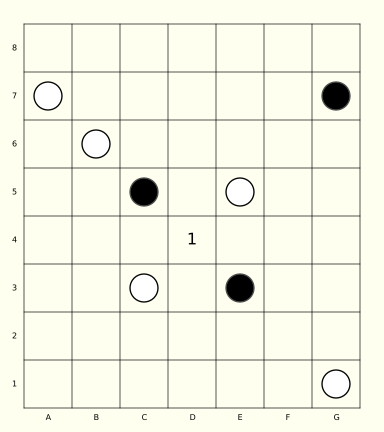
Each player has 17 pieces, and there's an extra neutral stone that starts at the central marked square.

Rules

  • Players alternately drop their pieces on empty squares, following these rules:
    • The first player drops one piece.
    • The second player then drop two pieces; the second must be directly east or west of the first.
    • The first player then drops two pieces; the second must be directly north or south of the first.
    • Play continues in this alternating double-placement pattern, with the required adjacency constraint depending on the previous opponent’s move.
  • Pieces cannot be placed on the square occupied by the neutral stone.
  • Pieces cannot be placed on a square that lies directly between two opposing pieces in a straight orthogonal line (unless that line is interrupted by the neutral stone or one of your own pieces).
  • If a player cannot drop their required second piece, they place only one. 
    • Passing is not allowed if a legal placement exists.
  • The game ends when all pieces are placed or no further legal placements are possible. 
    • For scoring, count all empty spaces that lie between two of your pieces in an uninterrupted orthogonal line. The player with the higher total wins the game.

Mar 9, 2026

Les Crocs

Les Croks is an uncredited game that appears in Patrick Carpentier rule's collection. Unfortunately, the document is very sparse with information. The only date we can deduce is that the game is older than 1995-2000, the years where the collection was written.

The game is played on an initially empty 6x6 board. Each player has ten pieces (les croks, i.e., the fangs) all marked with a direction (e.g., an arrow).

Rules:

  • In a first phase, players take turns dropping a friendly piece on an empty square. 
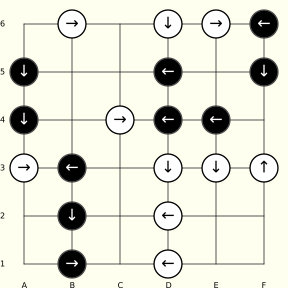
    • Here's a board example after the end of this phase:
  • In the second phase, each player picks a friendly piece and can either:
    • move it to an adjacent empty square
    • move it twice in its forward direction
    • rotate it one quarter left or right
    • capture by replacement in its forward direction, unless the enemy piece is faced towards it
      • in the previous board, d6 can capture d5, but e6 and f7 cannot capture each other
  • Wins the player that captures all enemy pieces

There is a related game at the same collection, quite probably by the same unnamed author, called La Saga des Croks.

  • Here players only drop six pieces each, the other four stay in reserve.
  • The capture is changed to emulate reproduction: it is only possible to attack from behind.
    • The 'jumped-over' crok is not removed from the game. 
    • On the next turn, the attacking crok slides to an adjacent orthogonal empty square without changing orientation, and the player places a new crok from the reserve on any empty square. 
    • This new Crok must not be in a 'capture' position.
  • Wins the player that drops on the board his four pieces initially in reserve.

This second game was also described at Jeux et Stratègie #28 by Michel Brassinne:

Dec 24, 2025

Thrall

Thrall is a 2005 game by L. Lynn Smith, published online.

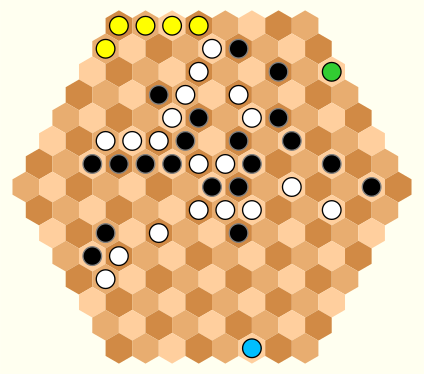
The game is played on the following hexagonal tiling:

Each player has one piece, and there are enough wall pieces on reserve.

Rules:

  • Initially, players drop their respective pieces on an empty hexagon
  • On his turn, first the player slides his piece over a line of empty hexes, then places a wall piece on an empty triangle
    • pieces cannot move between two occupied adjacent triangles
  • Wins the player that stalemates the adversary

In the following position, White is winning because he enclosed the black piece is a smaller area, comparing with the area his piece is confined.

There is a ZRF to play Thrall.

Dec 18, 2025

NoGo

NoGo is a 2005 game by John Moore.

This is a game using the concepts and rules of Go, with some simplifications.

Rules:

  • On her turn, the player drops a friendly piece on an empty intersection such that all existing groups of pieces (of either color) have, at least, one liberty (so, no captures or suicides are allowed)
  • Wins the last player to move

Black moved last; there is no valid drop left,
so Black wins the match

This is a game that can be analyzed by the tools of Combinatorial Game Theory. The game can be split in a sum of games, when parts of the board no longer interact. For example, using a one-dimensional NoGo, the game o..xxo..xx can be split and simplified by two (in this case equal) subgames: o..x and o..x; this type of property is crucial to computing large game positions.

Moore initially called the game Anti-Atari Go at Sensei's Library. The name No Go meant, back then, another different go variant: After a player has made a move, his opponent may refuse it, and he must make another one. The opponent may not object to this second move (this variant is now known as Forced Takeback Go at Sensei's Library).

There's a ZRF and a Ludii to play the game.

Dec 10, 2025

Intermezzo

Intermezzo is a 1993 game by Reiner Knizia, published in Spielbox magazine.

The game is played on 9x9 or 9x10 board initially empty. Each player has 33 pieces.

Rules:

  • On her turn, the player either:
    • drops a friendly piece on an empty square
    • calls an intermezzo on a friendly piece: then all horizontal and vertical lines of empty squares between that piece and other friendly pieces, are occupied with new friendly pieces
  • Wins the player that places all her stones on board

This position was shown in the original article:

after 12 moves, Black makes the first intermezzo on piece [1]

This is a pencil & paper game, no need for physical pieces to enjoy some matches.

The Spielbox article (in German):

Nov 19, 2025

Tris

Tris is a 2006 game by Daniel Solis.

The game is played on an 8x8 board, initially empty. Each player has enough pieces of one color (probably 40 is more than enough).

Rules:

  • On his turn, the player either:
    • drops a friendly piece, on an empty square, at the first/last row or vertically connected to another piece (or either color)

 all legal next drops shown

    • moves a piece to a horizontally adjacent empty square
      • then, the piece 'falls' until meeting another piece (falls in the direction of the edge supporting its column of vertically connected pieces)
      • if there were pieces on top of the moving piece, those pieces also 'fall' 

all movements available

  • If, after the drop/move, an orthogonal or diagonal 4 in-a-row of pieces of the same color is made, those pieces are removed from the board (cf. next rule for exceptions)
    • the remaining pieces fall accordingly, which might produce more 4 in-a-rows, and so on...
  • Fixed pieces: the pieces at the first/last row are fixed and cannot be removed
    • when a row is full, those pieces also become fixed
  • A player wins if either:
    • his first four rows are full
    • twelve of his pieces are removed

Comment from the author: Pretty simple game here, essentially taking elements of Tetris and Connect 4 and laying it flat on a board instead of vertically.

Sep 25, 2025

Pencil and paper games: Dots and Bugs

Pencil and paper games all share the property that each grid cell can only be used a very limited number of times (usually once or twice). Walter Joris is probably the game designer that most contributed to this genre with his 2002 book 100 Strategic Games for Pen and Paper. There's more recent Joris fun on his pinterest page.

Here are two pencil and paper games played in the Eastern bloc.

Dots. Played on a grid of any size - traditionally on a 39x32 grid typical of a squared copybook in Russia [wikipedia].

Each player draws a dot of his color on an empty intersection. If the player closes a chain of his own dots (including diagonal connections) and the interior includes at least one enemy dot, then the player connects his dots with lines. Those dots, including the inner area, are out of the game (let's say the player captures the area). The player scores one point per surrounded enemy dot. If the inner area does not have an enemy dot, then the player cannot capture that area. Also, if there are more than one option to close chains, the player must select just one of those to close.

When the board is full, the player with more points wins.

Usually, the game starts by playing a limited number of moves in a central area to prevent players moving initially in the borders (since those dots cannot be captured). A nice way to solve this problem would be to make a toroidal board, but at a probably high cost in clarity.

The wikipedia page mentions a variant that allows for knight-like connections, which encourages more offensive play. 

Another variant prevents a chain from scoring if it gets surrounded by a larger enemy chain.

An extra rule is the idea of Houses. A House is a chain that surrounds an area with only empty spaces. If the adversary moves there, and does not close a chain himself, then the House becomes a closed chain. This rule seems to open a cold phase at the endgame, when dots must be placed in the remaining intersections that penalize the players (getting the game closer to a no-pass Go).

§

The second game is Клоподавка (Bug Supression) aka Virus War. Again, the game is played on a large grid. The players decide on a move budget (say N usually between 3 and 6) relative to the size of the grid.

Each player has a home base, each on opposite corners. On his turn, each player marks N squares on the grid. Markings can be on empty squares, or by shading a square marked by the adversary (let's call it a wall). A wall becomes unplayable. However, players can only mark or shade squares that have a connected path from their home bases. 

A player that cannot complete his move, loses the game.

In the following example (with N=6) Blue answered Red's early and over-extended attack by making four walls, cutting red walls from the rest of their army. Now, if Red wants to reconnect, he must spend four markings to get to his three walls.
play this game here

Virus is a very underrated game, I find it quite fun to play and surprisingly tactical. Perhaps the game is too decisive, being hard to counter an early advantage, but who knows what good players could make of it?

Sep 15, 2025

Catch

Catch is a 1995 game by Reiner Knizia, published in Spielbox magazine.

The game is played on an 8x8 board, initially empty.

Each player has twenty pieces, and there are twenty domino-like tiles shared by both players.

Rules:

  • One player drops tiles vertically, and other player drops tiles horizontally
  • On his turn, the player drops one tile on two empty squares
    • For any enclosed area (either by tiles and/or board edges) with less than four squares, the player drops one friendly piece on each one of those squares
  • When there is no valid moves left, the game ends. Wins the player with more friendly stones

The next board shows a final position where the game ended in a 13-13 draw.

This is a pencil & paper game. There's no need for a board to enjoy this game.

I would suggest using an odd-size square board, like 9x9. These boards have an odd number of squares. Since any group of tiles only removes an even number of squares, the remaining pieces will amount to an odd number, making draws impossible.

Aug 28, 2025

Lambchop

Lambchop is a 2001 game by Dan Troyka, published online.

The game is played on a square board, say 5x5, initially empty.

Each player has just one piece (the lamb).

Rules:

  • Initially, the players drop their lamb on an empty square
  • On his turn, the player moves his lamb to an empty square
    • if the square is unmarked, the player marks it for himself (thematically, the lamb just eaten the grass of that square)
  • Wins the player with more marked squares

In the following position, White's turn to move, having each player marked nine squares. 

If White goes north to capture d5 and e5, he loses the game, since he would leave to Black three of the remaining seven grass (unmarked) squares. Then, White either captures b2 or a5, Black will capture the other.

There's a ZRF to play Lambchop. It includes several variants with different board sizes, and the use of more than one lamb per player.

Aug 23, 2025

Conflict

Conflict is a 2000 game by Alexander Stevens, published online.

The game is played on a 10x10 board, initially empty.

Each player has eight soldiers (myrmidons), twelve shields (bucklers) and four jumpers (assassins).

Rules:

  • Initially players take turns to drop their pieces in their first four rows
  • On his turn, the player moves a friendly piece:
    • soldiers and shields move like Chess queens
      • soldiers can only capture if they are in moving range from another friendly soldier
      • captures are by replacement
    • shields cannot capture or be captured 
    • assassins can move one or two steps in straight line, or jump over a piece landing in the immediate next square that must be empty or occupied by an enemy piece (that is captured)
  • Wins who capture all enemy soldiers.

The game originality is in the restricted capturing ability of soldiers. On the downside, the initial phase of dropping 48 pieces on board is not a good way to start a game.  It's too long. The game needs a fixed setup, just like Chess or Checkers (the old ones knew a thing or two). This is important to improve the game's interaction.


after grueling 48 turns,
all pieces are finally on board

Also, having twelve shields seems a bit too much. It might give an opportunity for very defensive tactics.

There is a ZRF to play Conflict.

Aug 10, 2025

Quintus

Quintus, or Quintun, is a 2003 game by Martin Windischer.

The game is played on a 10*10 hexagonal board. 

There are enough white and black pieces, and enough neutral stones of five different colors.

Definitions:

  • the 54 hexes on the edges are the ring
  • the remaining hexes are the playing area

Rules:

  • On her turn, the player either:
    • drops a friendly piece on an empty hex inside the playing area
    • drops, on the ring, one neutral piece of a new color
      • this piece must be at least five empty hexes from other neutral stones in both directions of the ring
    • drops, on the ring, two neutral pieces of a color already played
      • these pieces must be adjacent to pieces of the same color
  • Wins the player that either:
    • connects a friendly group with four different neutral colors
    • connects two friendly groups, each with three different neutral colors

In the next diagram (from a real match), White resigns: there's no possibility for his large group to connect to a third neutral color


This is imho a very good game, a connection game that does not have a fixed connection goal. The only point where this could be improved is in the condition of dropping the first neutral stone of a new color (so to remove the arbitrary distance of five empty hexes). The suggested new rule: 
    • drops, on the ring, one neutral piece of a new color in a side with no neutral pieces already in it (including corners) if this is possible, otherwise any ring hex
There are six edges for five colors. If a small number of neutral colors get to have large groups, a new tactical avenue would open by dropping the new neutral color anywhere in the ring.

Aug 5, 2025

Diagonal

Diagonal is a 2004 game by Luca Cerrato, published at Fogliaccio degli Astratti #23.

The game is played on an 8x8 board, initially empty.

Rules:

  • On her turn, the player drops a friendly piece on an empty square
  • After her move, the player scores as many points as the number of their pieces in the completed diagonals where the current piece belongs
    • a single piece color in a diagonal does not score
  • When the board is full, wins the player with highest score 

in this position, if Black plays [1] the score is 3 points
while if it was White playing at [1], the score is 3+3=6 points

Cerrato also proposes a variant, Diagonal Plus:

  • Initially, players drop a number of neutral pieces on board
    • These pieces are labeled with positive (bonus points) or negative (malus points) numbers
    • Bonus and malus points cannot be placed on the same diagonal.
    • For the 8x8 board, it is suggested to use: two pieces +2, one piece +3, one piece -2
  • It is forbidden to complete a diagonal using only neutral pieces (besides the dropped piece)
  • The scores should include the bonus/malus points besides the standard diagonal points

Jul 31, 2025

Fox Games: part 2

Fox games are not only from Europe. There are board games with asymmetrical forces in other places.

A well-known traditional game is  Baghchal from Nepal,

As BGG reviews:

At the start of the game, there are four tigers on the board while there are no goats. The goat player places his/her pieces on the board one by one wherever they choose, with the tiger player getting a move between each placing. Once all the goats are on the board, the two players take turns moving one of their pieces one space. A tiger can alternatively capture a single goat by jumping over it in a line to an empty space. The tigers win if they can capture five goats. The goal for the goats (who cannot make captures) is to hem the tigers in, giving them no opportunity to move or jump.

Other traditional examples are

  • Diviyan Keliya (Leopards and Cows) played in India and Sri Lanka
  • The medieval Cercar la Liebre (Catch the Hare) played in Spain, which derived to Coyote played in Mexico c.19th century

  • Len Choa (Len Cua Kin Ngoa) from Thailand [1]
  • Komikan (El Leoncito) from Chile with a first known reference from 1787 [2]

This ludeme is just too simple and attractive and continues to be used in modern games.

One example is 1975's Buffalo Chess (aka Bison) from Alex Randolph.

Ludii description:

Buffalos move one step forward to a free space. Dogs move like a chess queen but cannot capture. The villager moves like a chess king, and can capture buffalos. Dogs and the villager cannot enter the top or bottom rows of the board. Buffalos start, and win by reaching the top row. They lose if they cannot move anymore.

Another (less well-known) example is 1970 Carapace (aka Revanche):

The board is, in essence, hexagonal. The asymmetry here is more pronounced, where one player will win for sure. The adversary goal is resistance. A game consists of two matches, where players switch sides. Some spaces have extra value (check the number of dots in the previous board) that are used for scoring. Wins the player with the better score.

Steve Sisk wrote the next rules:

A modern variant -- in fact, more a puzzle than a game -- is the 2001's Wild Goose Chase by Dan Troyka:
 

The tame geese move one step orthogonally, while the wild goose is unable to capture, but moves like a Queen and is also able to fly to the adversary's first row. The geese have 15 turns to capture it. There's a ZRF to play it.

[1] Captain James Low, On Siamese Literature, Asiatic Researches vol.20[2] (1839)
[2] Thierry Depaulis, Inca Dice and Board Games, Board Games Studies 1 (1998)

Jul 13, 2025

Fox Games: part 1

Fox Games is a term to refer to classic games based on the idea of asymmetric forces. One side needs to encircle/block the adversary, while the other needs to escape or capture all enemy pieces.

Perhaps the oldest game in this family is Hnefatafl played in medieval Scandinavia, where one player with the central player tries to escape to the edge of the board.

The Ballinderry Halatafl-Board

Alea evangelii (Game of the Gospels) in a 11th century manuscript

A more well-known modern game is Fox and Geese where, instead of escaping the board, the Fox needs to capture all the Geese (by jumping over one piece at a time, checkers-like), while these can only try to block the Fox. The next board uses one fox against 13 geese (or hens, in this case),

Nouveau Jeu du Renard (The New Game of the Fox)
board from Collection de Jeux Anciens

Another variant is The Game of Assault (Le Jeu de Assaut), with more pieces, making the board more crowded: there are two defenders against 24 besiegers:

This previous board, c.1860, is from the game The Siege of Sebastopol (Jeu de l'Assaut de Sébastopol). The theme is based in the War of the Crimea

 
Assault games had several war motives over the 19th century; check the excellent blog Collection de Jeux Anciens for more examples. 
 
Here's another expanded version of the same game, Grand Jeu d'Assaut:
 

The next board is older, c.1814, again with a (rather abstract) military theme,

Two other games with foxes (renards in French),
 

patricia m, Flickr

This one has a sports-based theme:
 

A simpler version of this family was mathematically analyzed at Winning Ways, the bible of Combinatorial Game Theory (chapter 20 is dedicated to Fox Games),


This more abstract setup is older than Winning Ways, since it appears in 1938, published by Spear Spiele, and named 4 Gegen 1 (1 against 4).
 

An older version of this game is the La Chasse au Loup (The Wolf Hunt) published by Mauclair Dacier, c.1900:


There was a general alarm in the countryside: the wolf was seen coming out of the woods and, driven by hunger, wandering around the farms in search of prey. So the inhabitants, armed with guns, sickles, and pitchforks, tracked him, trying to drive him against a wall near the forest in order to kill him more easily.

In our game, the wolf is represented by a black piece or button, and the hunters by five pieces of a different kind. The Wolf is placed on a black square at a position of his choosing; the hunters are placed in a straight line along the lower edge of the board. The Wolf begins to play. He moves from one black point to another black point—right, left, forward, or backward—but never more than one step at a time. The hunters move only one step at a time and always forward; they may not move backward.

If the wolf manages to cross the hunters’ line, he wins. But if the hunters surround the wolf within their ranks, or drive him to one of the sides or corners of the board, the player controlling the hunters wins.

In 1940 in Germany a related game, this time on a larger 22x22 board, uses two asymmetrical armies in a naval context of U-boats and destroyers, 1940's Das U-Boot-Spiel:


The map is based on the actions of German U-boat Captain Gunther Prien, 
who sunk the British battleship ‘Royal Oak’ in Scapa Flow, Scotland, in 1939
 

One player has four destroyers and one taker (that start at the marked squares at the top rows), and the U-boat either at A or B. 

The original rules:

The rules are not too specific of how the pieces should move (automated translation):

Four destroyers (each represented by four stones of the same color) take their positions on the dotted squares, and the steamship on the square marked with “T”. The submarine surfaces either at “A” or “B”, whichever the attacker chooses for their first move. The destroyers must bring the steamer safely into the harbor, traveling around the island. The submarine tries to stop them, by surfacing in front of or behind the steamer, or by passing alongside it.

It moves only on brown squares, usually one square at a time. Contrary to the steamer, which moves diagonally forward only, the submarine may also move backward.  To make the game more difficult, some squares can be marked as minefields. If the steamer enters one of these marked squares, it is considered destroyed. If the steamer reaches the harbor safely, it is rescued; if not, it is sunk. How the battle unfolds is left to the intelligence of the players.

Apr 30, 2025

Atrio

Atrio is a 2000 game from Christian Gibon, published at LM Créations and Murmel Spielwerkstatt und Verlag AG.

The game is played on the following board (I was unable to find the initial setup),

Each player starts with three marbles, two regular and one special.

  • The regular marbles can move one space in each direction (orthogonal or diagonal)
  • The special marbles can move one or two spaces in the same directions

The goal is to place your marbles inside the center 9x9 area (inside the interior circle), or else to push out one enemy marble out of the board (outside the exterior circle).

If the moving marble is adjacent, in the moving direction, to an enemy marble, it will push the enemy marble. This is valid only if all spaces where the pieces move thru are previously unoccupied. The Ko rule applies, the next player cannot use the same pushed marble on the opposite direction of the previous move.

Apr 8, 2025

Babylon

Babylon is a 2003 game by Bruno Faidutti, published at Interlude (among others).

The game does not have a board, only twelve stackable tiles (three tiles for each one of four colors).

Initially, all tiles are placed in the gaming area. Let's denote a single tile as a stack of size one.

Rules:

  • On her turn, the player must place an entire stack on top of another.
  • A move is valid if either:
    • both stacks are of the same height
    • both stacks have the top-most piece with the same color 
  • Wins the player making the last move

This is a game that seems very amenable for analysis using Combinatorial Game Theory. But I'm not aware of any article studying it.

Mar 24, 2025

Hong Kong

Hong Kong is a 1999 Reiner Knizia building game, published at Platnik.

The game includes the 5x5 board, 40 standard building-blocks in two colours, ten fast building-blocks (in two colours, with white imprint), and ten roofs (in two colours).

The rules (also available at BGG):

Objective. The objective of the game is to control more buildings than your opponent, when all plots are occupied, or when all standard building-blocks and roofs have been used. A building is controlled by the player whose piece is topmost on it. 

On his turn, a player chooses one of the following options: 

  • to place one standard building-block
  • to place one roof
  • to place one fast building-block, followed by a standard building-block
  • to place one fast building-block, followed by a roof

Corresponding to his five fast building-blocks, each player has the opportunity five times, during the game, to perform a 'double' move. 

When placing pieces, the following rules apply: 

  • On the starting player's first turn, a piece may not be placed on the centre plot.
  • If a player places two pieces in a turn, he can place them on the same or two different plots.
  • Any type of piece can be placed upon any empty plot, even a roof.
  • No piece may be placed on top of a roof.
  • The maximum height of a building is five pieces.
  • Players may always place on top of their own building-blocks.
  • In order to place on top of an opponent's building-block, the player must control a building on an adjacent plot (i.e., with an edge in common) such that the newly placed piece does not create a building that is higher than the adjacent one. For this purpose, note that building-blocks are considered higher than roofs.

The game ends in one of two ways:

  1. when, at the end of a turn, all 25 plots are occupied; or
  2. when, at the end of a turn, all standard building-blocks (not necessarily all fast building-blocks) and all roofs are used up.

The player who controls more buildings wins. If both players control the same number of buildings, the player who controls the building on the centre plot wins.