Happy 45²

Labels:
art and history
 0
comments
0
comments
Cabale is a 1999 game by Roland Siegers, published at Goldsieber Spiele.

It's a blocking and scoring game for 2 to 4 players, with (too?) many different elements.
There's a video from channel Exacting Games explaining the rules:
And here are the rules (written by Jay Tummelson, taken from BGG).

Cabale is a rebranding of 1986's Winkeladvokat.
Labels:
old games
0
comments
I'm (re)reading the Jeux et Strategie magazine and, in issue 28, I found this,

At first I was hoping for a surprising little variant, but the rules, as I read them, just describes the classic Connect-4. Anyway, it made me think of a possible variant including captures: if the last placed piece has the effect of surrounding an enemy group, that group is captured, and all remaining pieces follow gravity. The player that makes the winning pattern wins (if both have a winning pattern, wins the player that just moved).
An example:
a) Black (X) to move
b) Black plays at 1, forcing White's 2, then answer at 3
c) White plays at 1 making atari at Black's left group, but Black plays at 2 capturing White's group
d) The white pieces are removed, and the black pieces fall down, making a 4 in-a-row
. . . . . . . . . . . . . . . . . . . . . . . . . . . . . . . .
. . . . . . . . . . . . . . . . . . . . . . . . . . . . . . . .
. . o x . . . . . . o x . . . . . 1 o x . . . . . . o x . . . .
. . x o x o . . . 3 x o x o . . 2 x x o x o . . . o x o x o . .
o . x o o o x . o 2 x o o o x . o o x o o o x . x x x o o o x .
x . x o o x x . x 1 x o o x x . x x x o o x x . x x x o o x x .
(a) (b) (c) (d)
I suspect that the game does not need a large space before either the game ends or captures become unavoidable.
There are two modifications that I think are needed:
Choosing an appropriate number of columns and rows for this ruleset is left as an exercise for the reader!
Labels:
new games
0
comments
A Dale Walton's game from 1984 published by Kadon.
Each player starts with five counters on the initial positions. There are also 18 tiles,

Each player must move their counters to the circles on the other side of the board.
At
the beginning the board is empty, and there are no paths to travel. The tiles are shuffled and stacked.
On his turn,
When all tiles are used, all remaining moves will imply a tile replacement (the removed tile is then used by the next player).
Notice that when paths cross, that means bridges not road blocks. Paths can also follow the paths printed onboard.
When a piece reaches one of its final circles, it can no longer move.
A player can pass, but it is illegal to have two passes in a row.

Labels:
old games,
rotating pieces
0
comments


A nice discovery!
Labels:
art and history,
older games
0
comments
Quads is a 1986 game by Edmond C. Leonard. It is territory game, as it is a Go variant,


But there are several other games called Quads: one a battleship clone and another a variant of dominoes.
But the fourth game, by Kris Burm at 1996, is a really interesting tiling game,


Labels:
old games
0
comments
After a long hiatus, I've been solving all the problems that arised due to the ephemeral features of the internet. Google services are becoming more and more unreliable, many diagrams and pictures were lost after one of those services was discontinued. I recovered most losses and the posts are back with all the original information. Also, I saved all photos in Github if blogger (which is owned by Google) also decides to lose this new batch of pictures. Life and work are constant fights against entropy, which is just a big word for loss.
Corona (Crowns) is a game from 1915 which the next picture were sent to me by Fred Horn.

It states it was manufactured by The Corona Company, game producers from Los Angeles, with a copyright from the 1910s (it's hard to see).
The picture of the board gives an extra clue, the copyright was from June 1915,

The printed rules are,


If we zoom in the top of the pieces box, we get some hard to read information,

But we find an alternative name, 'Crowns'. Using this information I went to Google patents and was able to find patent US87328614A from U. C. Upjohn, an application filed in Non, 21, 1914 and published at 1915-06-29, which corresponds to the board printed text. The board and patented ruleset is as follows,


Labels:
old games
1 comments
Inside my website World of Abstract Games, there is one page dedicated to Checkers variants. It includes regional rulesets and several other more recent inventions. Around 2001 or 2002 I included another one that I called "Board Draughts" with the following text:
In Board Draughts, each player also starts with 8 stones of the first two rows. Stones cannot capture and just move and jump forward. The goal is to move all stones to the last row (where they are removed from board). Wins the player with no stones left. I don't have information about if jumping is mandatory, but I would guess that it is.
The game rules were copied from the rule's book of a 200 pack game that I had bought several years before,

Of course, 18 years passed and I had completely forgot all about this.
Last November, Ralf Gering sent me an email asking for more details about Board Draughts. He had noticed that the rules, as stated, were not complete. It seemed that [Ralf's Words],
jumping must be mandatory, otherwise it would be just too easy to block the opponent's stones. Which leads to another question: What do you do if your stones are blocked, which can still happen (albeit rarely)? In my opinion the player who is blocked should lose the game (as in "normal" draughts), which would add another strategic layer to the game.
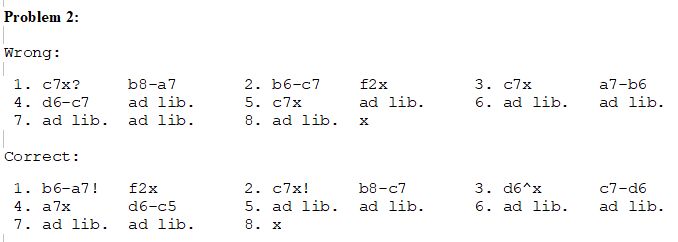
I agreed and included that on the ruleset. Ralf also gave a puzzle for this adapted game,
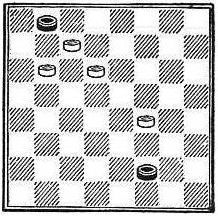
...and asked about the source of the original rules. I really didn't remember, but he was able to found some old email where I had mentioned the 200 pack game. I check it and indeed found the original text (in Portuguese),


Here there is also a Go-like variant where a group of surrounded checkers are captured and removed from the board. But at the time I didn't add it to the checkers page.
Anyway, I sent this information to Ralf and he was able to found a 1998 German edition called "200 Spiele: Viele Spiele für die ganze Familie", published by Peri-Spiele, an Austrian game business.

with the same game collection.
Ralf then commented,
Your game is actually called Halma-Dame in German! It was described by Erwin Glonnegger and Walter Diem in "Das große Ravensburger Spielebuch" (1974) [They also describe Blockade (=Bloqueio) just before they describe Halma-Dame!], by Hajo Bücken and Dirk Hanneforth in "Klassische Spiele ganz neu" (1990) and by Theo Hartogh in "Alte Brettspiele neu entdeckt: Mühle, Dame, Halma" (1999). The Portuguese translation is, however, misleading and (partly) outright wrong. According to the German sources pieces are allowed to leap over opponent's pieces, but that's not mandatory. The object of the game is to occupy the two farthest ranks that is the start position of the opponent. Pieces are never removed from the board. Nothing is said about blockades in the German rules.
So, my initial attempt to make sense of the Portuguese text, resulted in a (partially specified) new checkers game. I changed the checkers webpage to reflect this.
This is a small example of what I think is an important effect in the history of board games. Some regional variants, even new games, could have been created due to misunderstandings between people from different lands, communicating with difficulty without a proper shared language. Others might be born from reading underspecified rules or bad translations from books describing games. These misunderstandings produce ambiguity when trying to play the game afterwards, within your own family or community, and there is the need to create patches to make the game playable again. A bit like mutation in evolution.
Labels:
art and history,
new games,
old games
0
comments

Labels:
dominoes,
new games
0
comments


Labels:
new games
0
comments