Tricolor
Tricolor is a 1930 game by Maurice Kraitchik, and published at F.X. Schmid.
The game is played on a regular hexagonal board of size 5. The players have 18 pieces each that they place on their first three rows:
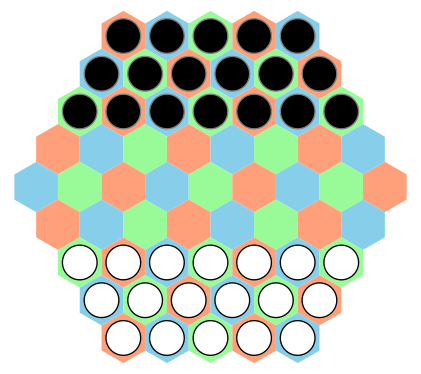
Definitions:
- Pieces are stackable and can be made of mixed colors. The stack owner is given by the color of the top piece
- The power of a stack is based on its size and the hex it is on
- The base power is the number of friendly pieces in the stack (up to a maximum of three)
- If the stack lies on yellow hex its power multiplies by 1; green multiplies by 2, red by 3
- note: the hex colors used in the post's setup diagram are not the same, please check the board below

- On his turn, the player moves one friendly stack
- A stack with N friendly pieces moves up to min(3,N) hexes in a single direction (no turns are allowed)
- Stacks cannot jump over stacks (friend or foe) but can land on top of friendly stacks
- A stack can split when moving, leaving the bottom part in the initial hex (the part that stays may change owner, depending on its top piece); the moving range of the top part is given by its number of friendly pieces
- A less powerful enemy stack, in moving range, must be attacked (attacks take precedence to simple moves)
- The attacker moves on top of the attacked
- If the attacking stack is more than twice as powerful, the enemy pieces in the attacked stack are removed from the game (this is called killing)
- If not, the enemy pieces stay on the stack, and the order of the pieces remains unchanged (this is called capturing)
- If there are several attack options, the player decides which to execute
- Wins the player that captures and/or kills all the enemy pieces, or stalemates the adversary.
There is a price to pay for stacks with more than three friendly pieces, since these stacks stop having more power after three pieces. The only advantage is the ability to split the stack and maintain more moving range. Not sure if this is worth the risk of having many pieces in the same stack. However, the rule makes sense, to prevent players to build a singleton stack with immense power.
Ralf Gering comments on BGG referring some tactics:
- Force your opponent to capture on weak hexagons;
- A war is won by sacrifices;
- Invasions into enemy territory are more dangerous for the aggressor;
- Be smart when you dismantle a big stack!
§
Tricolor is one of the oldest stacking abstract games, after Bashni and Laska (which inspired Tricolor). It also has an option for three players (check original rules below).
Here is the first reference of the game on Kraitchik's 1930 book, Le Mathématique des Jeux (the following pages are from Dover's second edition, 1953),


Here's a review on Games & Puzzles #32:

This is one of the first hexagonal board games with stacking pieces.
I know only of one older example, and it is from US patent 437838, by Heinrich Sperl, that designed a game that was never commercialized (afaict) and, so, is quite obscure:


Labels:
older games,
stack pieces

1 comment:
Very interesting!
Post a Comment